
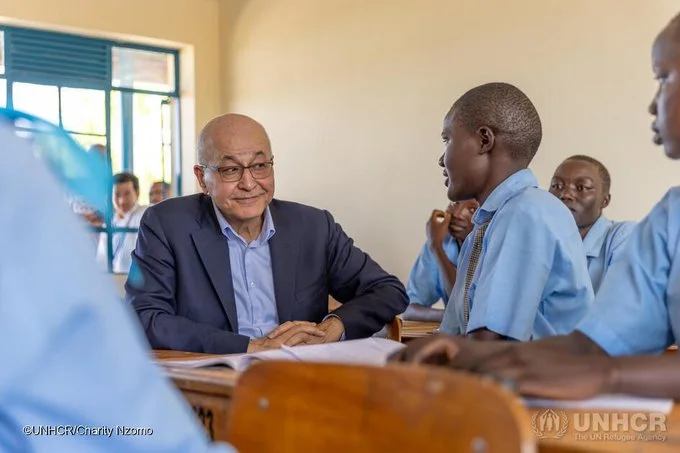
United Nations High Commissioner for Refugees Barham Salih has called for a shift from long-term dependence on humanitarian aid to sustainable solutions that allow displaced people to rebuild their lives, as the agency struggles with a major funding shortfall that threatens its ability to meet growing needs.
Addressing the UNHCR Executive Committee in Geneva on October 12, 2026, for the first time since taking office, Salih urged governments and international partners to expand opportunities for refugees through employment, education, business and access to financial services while maintaining protection for those escaping conflict and persecution.
He said humanitarian assistance remained essential for people forced to flee their homes but argued that long-term displacement should not leave millions unable to support themselves or plan for their future.
“We must protect people when they are forced to flee, but we cannot accept indefinite displacement as their future,” Salih said. “We must measure success not only by the lives we save, but by the lives people are able to rebuild, and the lasting solutions they can find.”
Salih, who assumed office in January, said his first nine months as head of the refugee agency had strengthened his belief that responses to displacement must go beyond emergency relief and create pathways towards lasting independence.
During that period, he visited 15 UNHCR operations in countries including Chad, Ukraine, Ethiopia, Afghanistan, Syria and Venezuela, where he assessed the challenges affecting refugees and the communities hosting them.
Drawing from his own experience of forced displacement and his previous role as head of state, Salih acknowledged that governments face difficult choices when responding to humanitarian emergencies. However, he said those decisions have lasting effects on people seeking safety and the countries expected to support them.
“I know what it means to need protection. And I know the difficult decisions governments must make. I understand how profoundly those decisions can shape people's lives,” he said. “The pressures are real. So are our responsibilities.”
UNHCR targets 14.5 million refugees
A central part of Salih's strategy is UNHCR's “50 by 35” vision, which aims to halve the number of refugees living in prolonged displacement in low- and middle-income countries who depend on humanitarian assistance to survive.
The plan targets approximately 14.5 million refugees who currently rely on aid and seeks to improve their access to jobs, financial services, business opportunities and higher education.
Through these opportunities, the agency hopes to help displaced people become more financially independent while allowing them to contribute to the economies of the communities hosting them.
To support the goal, UNHCR announced a Global Strategy for Self-Reliance designed to expand refugees' access to employment, finance, entrepreneurship and markets.
The agency also plans to establish a 50 by 35 Accelerator that will provide flexible, multi-year funding for programmes focused on self-reliance, inclusion and lasting solutions for displaced populations.
Another component, known as the Aiming Higher initiative, will focus on increasing access to universities and other forms of higher education for refugees.
UNHCR intends to work with governments, development institutions, private-sector organisations, civil society and refugee-led groups to put the measures into practice.
Salih stressed that the plan was not a move to withdraw essential support from people who still need humanitarian assistance. Instead, he said, its purpose was to reduce the number of people who have no option but to rely on aid for their survival.
“50 by 35 is not a target to reduce humanitarian assistance. It is a commitment to reduce the need for it,” he said, adding that the success of the initiative should be judged by improvements in people's lives and their ability to become self-sufficient.
Funding shortages put pressure on refugee response
The push to expand self-reliance comes as UNHCR faces a major gap between the resources available to it and the amount required to meet the needs of displaced populations around the world.
The agency's 2026 budget stands at $3 billion, equivalent to about 35 per cent of the $8.5 billion it estimates is needed to carry out its work.
Its workforce has also dropped by more than a third, falling from nearly 20,000 employees in 2024 to just under 12,000 following efforts to tighten financial controls and improve how the organisation uses its resources.
Salih said the changes were intended to help UNHCR maintain its protection and assistance work despite financial pressure. However, he warned that improving efficiency could not make up for a lack of adequate funding.
The financial strain also affects countries hosting refugees, many of which must provide support despite having limited resources of their own.
According to Salih, 80 per cent of refugees live in countries that together account for only 27 per cent of global wealth, highlighting the gap between the responsibilities host nations carry and the resources available to them.
“Inclusion cannot be financed by goodwill alone,” he said, calling for stronger international financial support for countries providing shelter and opportunities to displaced people.
He identified the 2027 Global Refugee Forum as an important opportunity for governments and international partners to address the gap between promises made to refugee-hosting countries and the funding actually provided.
The forum is expected to provide an opportunity to renew attention to the support required by countries that continue to shoulder much of the responsibility for hosting refugees.
UNHCR chief calls for continued refugee protection
Despite the focus on economic independence, Salih reaffirmed that refugee protection must remain at the centre of international efforts to respond to displacement.
He called on governments to uphold the principles of the 1951 Refugee Convention, which sets out protections for people fleeing persecution and includes safeguards against returning refugees to places where their lives or freedom would be threatened.
Salih's appeal placed responsibility on governments to balance efforts to manage migration and humanitarian pressures with their obligations to people seeking safety.
He maintained that providing refugees with opportunities to work, study and establish businesses should go hand in hand with protecting those who cannot safely return home or are not yet able to support themselves.
The UNHCR chief concluded by urging world leaders to honour their commitments to displaced populations, warning that their actions today would shape how future generations judge their response to people forced to flee their homes.
His message combined a call for greater financial support with a push for practical measures that would help refugees move beyond prolonged dependence on humanitarian assistance and build more secure futures.