
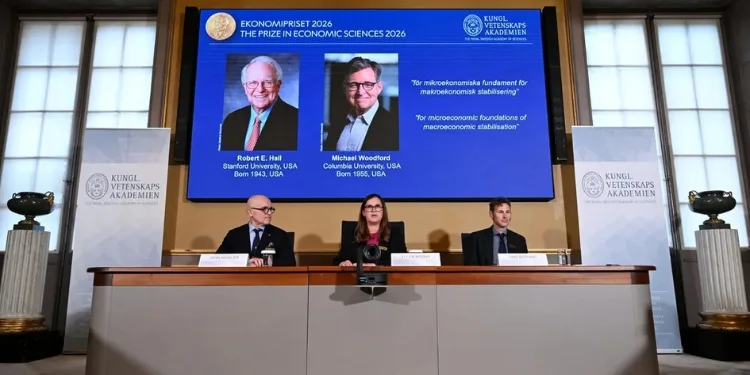
American economists Robert Hall and Michael Woodford have won the 2026 Nobel Memorial Prize in Economic Sciences for their work on how governments and central banks can stabilise economies during periods of uncertainty.
The Royal Swedish Academy of Sciences announced the award in Stockholm on Monday, October 12, recognising the pair “for microeconomic foundations of macroeconomic stabilisation”.
The prize, formally known as the Sveriges Riksbank Prize in Economic Sciences in Memory of Alfred Nobel, is worth 12 million Swedish kronor, approximately $1.2 million.
Hall is affiliated with Stanford University in California, while Woodford works at Columbia University in New York. Their research has helped develop economic models that explain how policy decisions affect households, businesses, and the wider economy.
The award recognises their contribution to explaining how monetary and fiscal policies can reduce the severity of economic fluctuations.
Central banks conduct monetary policy through measures such as interest rate changes, which influence borrowing costs, spending, and investment. Fiscal policy, meanwhile, involves government decisions on taxation and public spending.
When an economy slows, central banks may reduce interest rates to encourage borrowing and investment, while governments can increase spending or adjust taxes to support demand. During periods of excessive inflation, policymakers may restrain spending and ease price pressures.
However, the effectiveness of such interventions depends on how households and businesses respond to policy changes, as well as on the timing and scale of the measures.
The laureates' work has helped establish a theoretical foundation for economic models that account for these responses when assessing the likely impact of policy decisions.
John Hassler, chairman of the Committee for the Prize in Economic Sciences, said their work had provided a stable theoretical foundation for models now used by central banks and governments around the world.
He added that the research had improved policymakers' ability to respond to economic shocks, including energy crises and sudden changes in household consumption.
Woodford described the recognition as a surprise and a tremendous honour, according to the Associated Press.
The economics prize is the final award announced in this year's Nobel season. Unlike the original Nobel Prizes established under Alfred Nobel's will, Sweden's central bank created the economics award in 1968 and first presented it in 1969.
The Royal Swedish Academy of Sciences awards it and presents it alongside the other Nobel prizes at the annual ceremony on December 10, the anniversary of Nobel's death.
Last year's economics prize went to Joel Mokyr, Philippe Aghion and Peter Howitt for research into how technological innovation drives economic growth through the process known as creative destruction.