
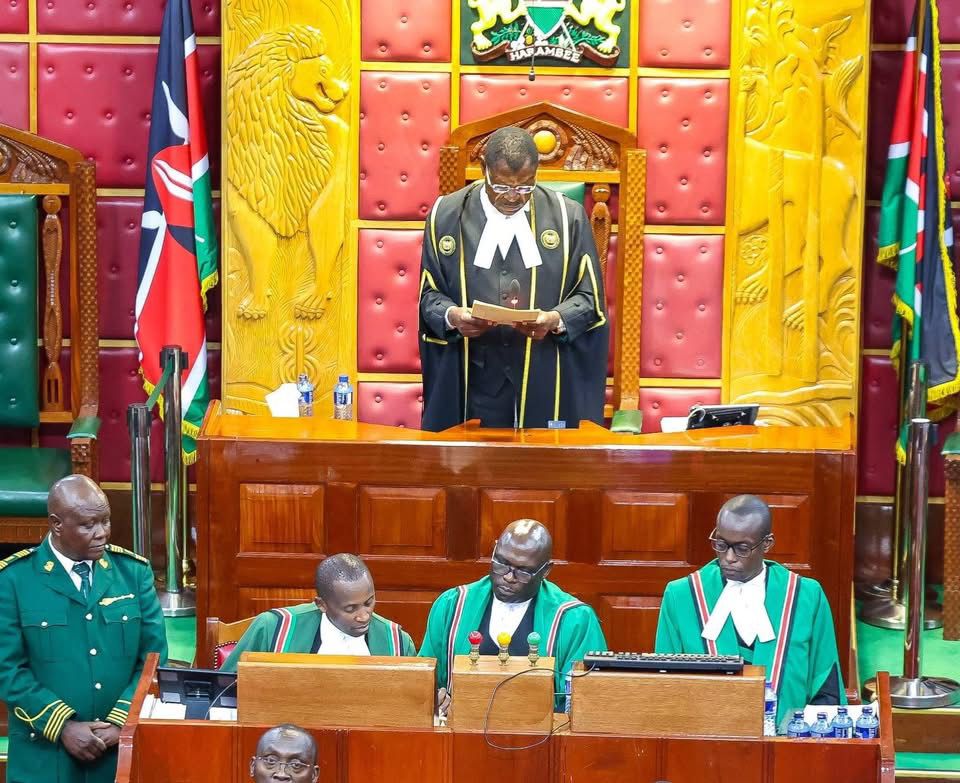
A fresh fight over access to government jobs has emerged after claims by National Assembly Speaker Moses Wetang’ula that some lawmakers are handed TSC employment letters, with MPs now alleging that similar political influence extends to the recruitment of police officers, soldiers and prison officers.
The controversy has raised questions about whether young Kenyans who spend days preparing for and attending recruitment exercises are competing on equal terms or whether some positions are already secured for people with political connections.
According to the Star, Gatanga MP Edward Muriu said the alleged practice was particularly common in the disciplined services, where he accused the government of using employment opportunities to reward political supporters.
“It is worse, matters pertaining to employment are supposed to be attained on merit but what Ruto has decided to do is to reward the people who support him with employment, be it for teachers, police and military,” he said.
Muriu further claimed that some politicians who receive appointment letters for distribution in their constituencies have turned the opportunity into a source of income.
“To make matters worse, the ones who have been given the appointment letters to take them to their constituents have made it a cash cow.”
He said the concerns surrounding the hiring of teachers should not be treated as an isolated matter, claiming that the same pattern was being seen in the security services.
“It is happening in police and the military and that is how Ruto is buying support,” he claimed.
The allegations came after Wetang’ula said some MPs aligned with the government are taken to State House, where they allegedly receive TSC letters that are later used to recommend people for teaching positions.
“There are some of our MPs whom I personally take to State House to see President William Ruto. The President then gives them 10 TSC letters each, which they are supposed to use to recommend teachers for official government employment. However, they sell these letters to Kenyans for Sh400,000 each,” Wetang’ula said.
Wetang’ula said the alleged sale of employment opportunities should attract legal action, warning that corruption should not be allowed to determine who gets a government job.
“We will not tolerate such behaviour. If your MP is doing this, they should be prosecuted. Bribery and corruption have no place in our country, Kenya,” Wetang’ula said.
His remarks have since placed MPs who have benefited from government employment opportunities under pressure to explain how they secure positions for their constituents.
Nyandarua Woman Representative Faith Gitau acknowledged receiving opportunities to assist teachers but denied ever asking beneficiaries for money.
“Yes, I have been given [employment] for teachers but I have never asked for money from anyone. I challenge any teacher whom I have helped get a job and asked for money from them,” she said.
Gitau also disputed Wetang’ula’s account that he had personally taken her to the President to receive TSC letters.
“I also challenge Speaker Wetang’ula to prove that he has ever taken me to the President to get letters. Maybe he takes MPs from his place.”
Mukuruwe-ini MP John Kaguchia said the allocation of employment opportunities to political allies was not a new allegation.
According to Kaguchia, MPs who support the administration are more likely to receive slots, while those who oppose it are left out.
“The slots are always given to pro-government MPs. It is not the first time it has been said,” Kaguchia told the Star.
Ruaraka MP TJ Kajwang’ appeared to defend the involvement of elected leaders, saying constituents would welcome any assistance that helped them secure employment.
“If I could get the letters from wherever quarters and give them to residents of Ruaraka constituency, they would be happy. They would vote me in,” Kajwang’ said.
Kajwang’ did not say that he had received such letters, instead challenging Wetang’ula to explain the claims before the National Assembly.
“As to whether Speaker Wetang’ula went out there and said what he said, we will wait for him on the floor to tell us where those letters are. If he is holding them in his office, we will break that door to get those letters,” he said.
The claims have also sparked concern over the fairness of recruitment into public institutions, with leaders questioning whether politicians should have a say in choosing people to occupy government positions.
Those opposed to the alleged system argue that it could shut out qualified Kenyans who have no political connections. They say recruitment should be based on qualifications and merit rather than an applicant's links to a politician.
The controversy has also drawn attention to the independence of constitutional commissions, particularly the TSC, which is responsible for teacher recruitment.
Former Law Society of Kenya president Faith Odhiambo said allowing political leaders to influence teacher hiring undermines the commission's constitutional role and reduces the chances of qualified teachers getting jobs through a fair process.
“This is not a joke. This is not politics as usual. This is a constitutional violation. When the State House, the speaker, and MPs turn teacher recruitment into a patronage scheme, they are not just bypassing the TSC,” Odhiambo said.
“They are dismantling one of the key independent institutions designed to protect public service from capture.”
The dispute has also taken a political turn, with some leaders demanding Wetang’ula's removal from the Speaker's position over his remarks.
Mbae said lawmakers should consider starting proceedings against Wetang’ula, arguing that his comments point to a serious breach of the Constitution.
“I want to urge members of the National Assembly in respect of this constitution, somebody should go and file a motion to impeach the speaker,” Mbae said.
“When the speaker says they give MPs TSC letters, that is killing the constitution.”
The growing dispute has consequently shifted attention from the alleged sale of TSC letters to the wider question of political involvement in government recruitment, particularly in areas where thousands of young people compete for limited positions in the security services.