
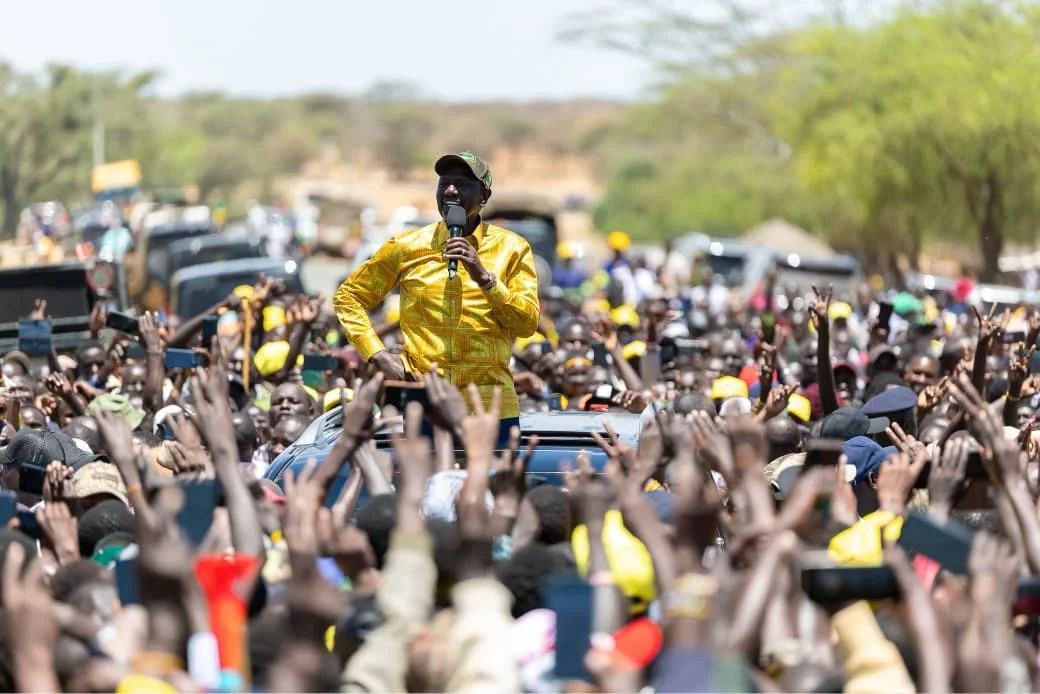
President William Ruto has described Kenya’s opposition leaders as the weakest the country has had since independence, accusing them of relying on ethnic mobilisation, hatred and divisive politics instead of offering alternative development policies.
The President said Kenyans had moved beyond tribal politics and were demanding leaders with clear agendas capable of addressing the country’s economic and development challenges.
Speaking during development tours of West Pokot and Trans Nzoia counties on Wednesday, Ruto maintained that the Kenya Kwanza administration’s 2022 manifesto remained the main development blueprint guiding the government.
“The current opposition leaders are the weakest Kenya has ever had since independence and the return to multi-party politics in 1992,” he said.
He accused his political rivals of lacking alternative ideas and resorting to ethnic mobilisation to gain public support.
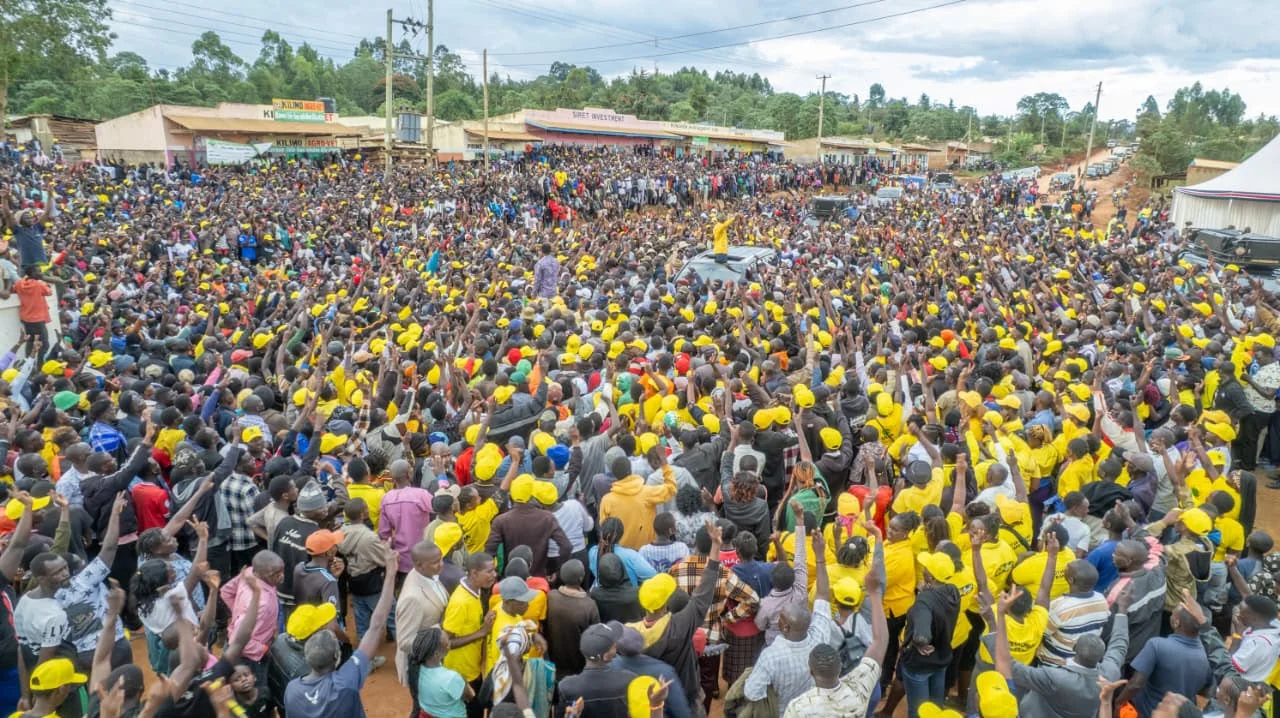
In 2022, Ruto said, Kenyans “buried the politics of tribalism”, adding that political competition should be based on policies and development records rather than ethnicity.
“That is why Kenyans continue to hold us accountable for the promises we made in our manifesto because we presented a plan to the people,” he said.
The President cited affordable housing, universal healthcare, agricultural revitalisation, financial inclusion and youth empowerment as some of the programmes the government was implementing.
“It is now clear that the results of what we are doing speak for themselves,” he said.
He challenged the opposition to present alternative proposals rather than focus on divisive political rhetoric. Ruto also criticised an unnamed opposition party, accusing its leaders of seeking contributions from women and spending the money on drinking.
Beyond the political exchanges, the President announced and inspected several infrastructure projects aimed at improving connectivity and expanding access to electricity in the two counties.
In West Pokot, he inspected the construction of the Kapsait-Kapsangar-Tapach-Sondany road, which is expected to extend to Ortum at a cost of Sh2.3 billion.
“The road is part of the Sh21 billion investment in West Pokot to build 200km of roads to improve connectivity and open up the region to greater economic opportunities,” he said.
Ruto also flagged off a Sh336 million Last Mile Electricity Connectivity Project in Pokot South, targeting 1,960 households.
Across West Pokot County, the government is investing Sh2.3 billion to connect 10,000 homes to electricity, according to the President.
He further announced a Sh1 billion electricity connectivity investment in Kacheliba Constituency, describing it as the largest allocation to a single constituency in the country.
At Konyao, he launched the first phase of the power project and the Sh1.84 billion upgrading of the Konyao-Kiwawa section of the Lodwar-Lorugum-Lorengippi-Loya road.
In Trans Nzoia, Ruto highlighted the government's efforts to integrate information and communication technology into public junior schools through the provision of laptops and interactive smart boards.
“So far, we have equipped 10,382 schools, accounting for nearly 50 per cent of all public junior schools, and trained more than 64,000 teachers,” he said.
He said the government intended to equip all public junior schools by April 2027. The President made the remarks at Kiminini Comprehensive School, where he also commissioned a 27-classroom tuition block.
Ruto launched the first phase of the Kiminini-Mitoto-Ndalu-Brigadier road, which will cost Sh500 million, and pledged an additional Sh1 billion towards its completion.
He also cited a Sh7 billion investment in the expansion of the Maili Tisa-Kitale road and said the government was investing Sh18 billion to construct 270km of roads across Trans Nzoia.
The President also launched a Sh922 million electricity connectivity project targeting 8,792 households in the county.
Cabinet Secretaries Kipchumba Murkomen and Opiyo Wandayi, West Pokot Governor Simon Kachapin, Bungoma Governor Ken Lusaka and several legislators accompanied the President during the visits.