
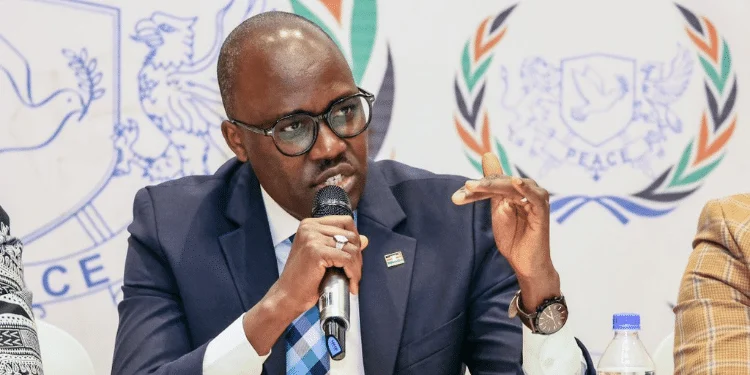
Foreign Affairs Principal Secretary Korir Sing’Oei has expressed confidence in Kenya’s ability to contain the Ebola outbreak after the country confirmed its first case of the virus.
Sing’Oei said the case demonstrated the importance of containment measures that the government had already established in different parts of the country to respond to health emergencies.
“Regrettable as it may be, this case attests to the importance of containment capabilities which the government had already put in place in various parts of the country to deal with such contingencies. We are confident that our country’s health authorities will deal with this situation effectively,” he said in a statement posted on Tuesday.
The assurance came after the Ministry of Health confirmed on Tuesday that a Kenyan national who had been living in the Democratic Republic of Congo (DRC) had tested positive for Ebola Bundibugyo and died.
Health Cabinet Secretary Aden Duale said the patient travelled back to Kenya by road through Uganda before flying to Nairobi on October 3.
The man had fallen ill about a month earlier and received treatment in the DRC before making the journey to Kenya.
Duale said the patient was screened at the airport after arriving in the country and was taken directly to a Nairobi hospital in line with health protocols.
He developed “fever, chills, intense fatigue, weakness, muscle pain, painful swallowing, sore throat and bleeding under the skin at the injection sites”.
The patient later tested positive for Ebola Bundibugyo and died on Monday night, only days after arriving in Nairobi.
Health authorities have identified 27 people who came into contact with him, including relatives and healthcare workers.
Officials are also working to trace 23 passengers and four crew members who were on the same flight as the deceased.
Duale urged Kenyans not to panic, saying the government had activated measures to limit the spread of the virus.
“I wish to assure the public not to panic, as all systems are in place to mitigate the spread of the disease,” Duale said.
The government has also made arrangements for the deceased to receive a “safe and dignified burial” in line with public health standards.
Kenya's first case comes amid an ongoing Ebola outbreak in the DRC, where the Bundibugyo strain was reported in mid-May. The outbreak is the DRC's 17th Ebola outbreak.
The WHO had recorded 8,463 cases and 4,082 deaths in the DRC as of October 2 since the outbreak was reported.
Uganda, which shares a border with Kenya, confirmed its first case in the current outbreak on June 21. The country recorded 20 cases, most involving people who had travelled from the DRC, and two deaths before being declared Ebola-free on August 27.
The confirmation of Kenya's first case has also brought renewed attention to a proposed Ebola isolation and quarantine centre in Nanyuki that sparked protests in June.
Residents and activists opposed the US-backed facility, citing concerns over public health risks, transparency and sovereignty.
The High Court suspended construction of the centre and ordered the government to disclose agreements linked to the project.
At the time, Kenya had no confirmed Ebola cases.
The government defended the proposed 50-bed isolation and quarantine facility, saying it was mainly intended to support US citizens exposed to Ebola in the DRC.