
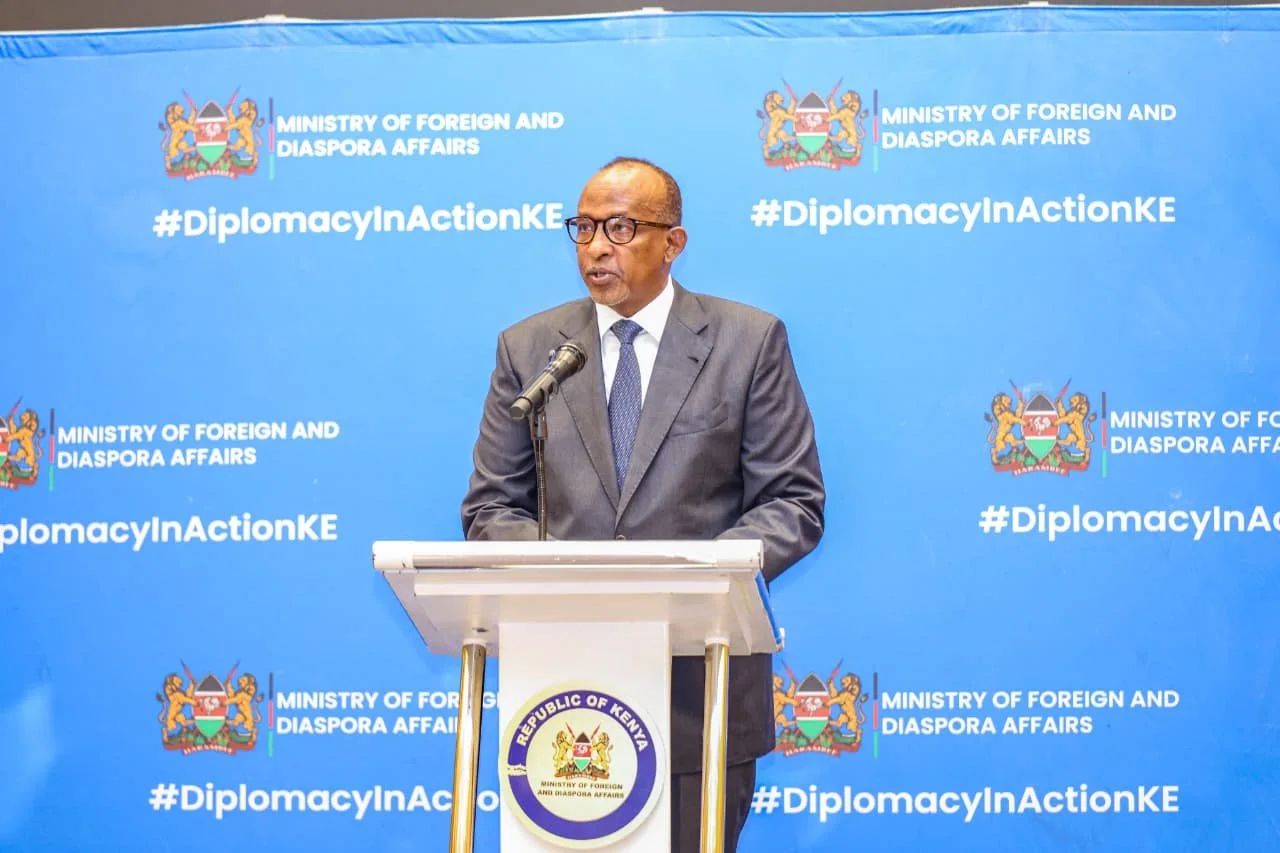
Health Cabinet Secretary Aden Duale has taken aim at Democratic Party of Kenya leader Justin Muturi after the former Attorney General called for an independent inquiry into the handling of a suspected Ebola case at Jomo Kenyatta International Airport (JKIA), raising questions about passenger screening, hospital procedures and the possible exposure of other people.
The disagreement followed Muturi’s demand for a detailed account of how a traveller who reportedly arrived in Kenya from the Democratic Republic of Congo (DRC) was cleared at the airport and later taken to hospital.
In a post on X on Monday, October 12, 2026, Duale responded with a remark directed at the DP leader, appearing to question his understanding of the matter.
“The most dangerous leader is not necessarily the one who knows nothing, but the one who knows very little and believes he knows everything, and that’s Hon Muturi.”
The Health CS’s response came hours after Muturi raised concerns over information he said had been shared with him by a whistleblower, calling for an independent investigation to establish whether the authorities had followed the required public health procedures.
Muturi questioned the circumstances surrounding the traveller’s clearance at JKIA, the handling of the patient after arrival at hospital and whether adequate steps had been taken to identify people who might have come into contact with the individual.
In his statement, Muturi said the information presented to him by a whistleblower pointed to possible gaps in the handling of the traveller at the airport.
He claimed the information suggested that the individual was cleared after a telephone communication rather than being subjected to the required screening procedures.
The former Attorney General also raised concerns about what happened after the traveller was taken to hospital, saying the patient, referred to in his statement as Patient Zero, may have interacted with medical workers, other patients and members of the public.
He questioned whether the medical team had received complete information about the patient’s travel history, arguing that such details would be important in assessing possible exposure to the virus.
Muturi further sought clarification on whether family members visited the patient during the hospital stay and whether those visits had been considered when assessing the possibility of contact with other people.
He warned that questions surrounding the case should not be dismissed as political disputes, insisting that public safety required clear answers from the relevant authorities.
“The safety of our nation is not a matter for political games, administrative excuses, or carefully crafted statements issued after public confidence has already been shaken,” he said.
Muturi said the concerns needed to be independently verified to establish whether the proper health safeguards had been observed and whether anyone else might have been exposed to the virus.
He maintained that the authorities needed to provide a clear account of the events rather than leave unanswered questions about the management of a suspected infectious disease case.
Muturi also directed his questions at Duale, seeking an explanation of the screening and reporting procedures that were in place when the traveller entered Kenya.
He wanted to know whether healthcare workers had been informed about the patient’s travel history and possible risks before providing treatment.
The DP leader also questioned whether medical personnel had been adequately protected and whether individuals who might have come into contact with the patient had been identified and professionally assessed.
“What exactly happened? Were established screening and reporting procedures followed? Were healthcare workers adequately informed and protected? Were individuals who may have been exposed identified and professionally assessed? What treatment, monitoring, contact tracing, and preventive measures were put in place, where clinically indicated?” he asked.
The questions highlighted Muturi’s concerns about the handling of the case from the point of entry into the country to the patient’s admission to hospital and the subsequent assessment of possible contacts.
He called on the Ministry of Health, airport authorities and the hospital involved to secure all relevant records to help establish what happened at each stage.
According to Muturi, preserving the records would allow an investigation to establish the sequence of events and determine whether the required public health procedures had been followed.
He said an independent inquiry should establish whether any safeguards had been breached and recommend changes to prevent a similar incident from occurring in the future.
His demands also focused on whether the authorities had taken appropriate steps to identify and monitor people who might have been exposed, where necessary.
However, the claims concerning the traveller’s clearance, hospital interactions and possible exposure of other people have not been independently confirmed in the information provided by the two leaders.
Government declares Ebola a formidable epidemic disease
The dispute comes as the government steps up preparations to detect and control Ebola, including screening at entry points, isolation, contact tracing and monitoring of people who may have been exposed.
On Monday, October 12, 2026, Duale gazetted the Public Health (Declaration of Formidable Epidemic Disease) Order, 2026, declaring Ebola caused by the Bundibugyo virus a formidable epidemic disease.
The government also published new rules outlining measures for identifying and controlling the disease.
The announcement came as Muturi called for greater openness from the Ministry of Health over the handling of the suspected case, arguing that the public needed timely information about the measures being taken to protect the country.
He said the authorities should provide an account of their response without compromising patients’ confidentiality.
Muturi’s concerns centred on whether the airport screening process had been properly conducted, whether the hospital had received the necessary information and whether the authorities had assessed the risk to people who might have interacted with the patient.
He also called for clarity on the protection provided to healthcare workers and the steps taken to identify possible contacts and put appropriate monitoring measures in place.
The former Attorney General maintained that an independent investigation would help establish whether the relevant procedures had been followed and whether any weaknesses needed to be addressed.
The reported circumstances of the case, including the process through which the traveller was cleared at JKIA and the possibility that other people were exposed, remain subject to verification by the relevant authorities.