
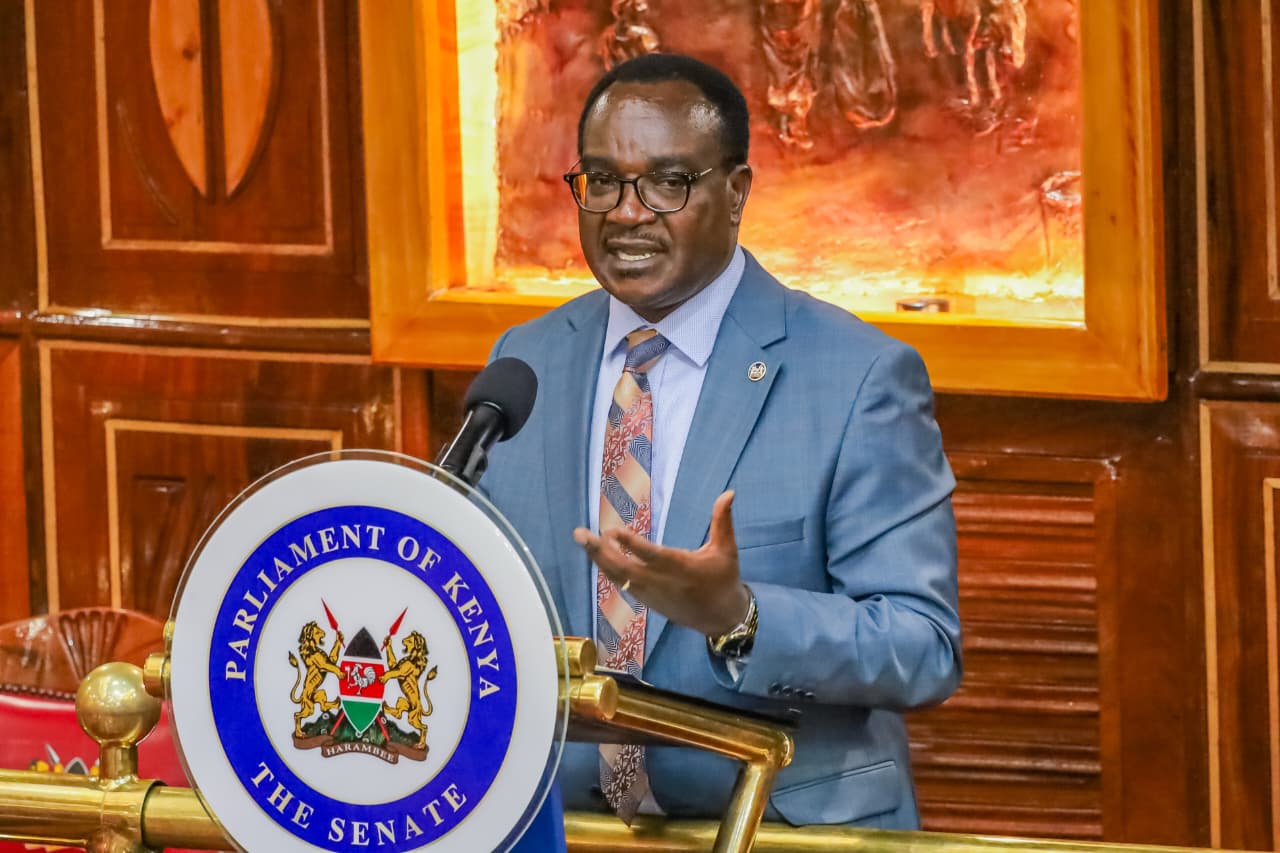
The Ministry of Education has defended recruitment in public Technical and Vocational Education and Training (TVET) institutions, telling the Senate that all 47 counties are represented in the sector's workforce and that hiring has been conducted in line with constitutional requirements on diversity, inclusivity and equal opportunity.
Education Cabinet Secretary Julius Migos Ogamba made the remarks while appearing before the Senate Standing Committee on National Cohesion, Equal Opportunity and Regional Integration to respond to concerns raised by Senators Mohammed Chute and Beth Syengo over recruitment practices in public TVET institutions.
Ogamba told the committee that the country's 246 public TVET institutions employ 23,388 teaching and non-teaching staff across National Polytechnics, Technical Training Institutes and Technical and Vocational Colleges. He said Bungoma has the highest number of employees at 1,433, followed by Kakamega with 1,323, Kisii with 1,212 and Nandi with 1,153, adding that every county is represented in the workforce.
He also said men account for 56.8 per cent of employees while women make up 43.2 per cent, a distribution the Ministry said complies with the constitutional two-thirds gender principle.
The Cabinet Secretary further revealed that the Government has recruited 3,300 TVET trainers since 2022, including 1,300 during the 2022/2023 financial year and another 2,000 in 2023/2024. He explained that recruitment follows a structured process in which institutions declare vacancies before approvals are granted by the Public Service Commission and the National Treasury, after which positions are advertised, candidates shortlisted, interviewed and appointed.
Defending the hiring process, Ogamba told senators:"I wish to affirm that TVET institutions, like other public sectors employers, are strictly bound by the provisions of the law and policy on inclusivity, diversity and equal opportunity in recruitment, employment and promotions."
He said recruitment is guided by Article 232(1) of the Constitution, which requires representation of Kenya's diverse communities and equal opportunities for men, women, members of all ethnic groups and persons with disabilities.
"The highest edict in this regard is found in Article 232(1) of the Constitution, which outlines the values and principles of public service to include representation of Kenya's diverse communities; and affording adequate and equal opportunities for appointment, training and advancement, at all levels of the public service, of men and women; the members of all ethnic groups; and persons with disabilities."
Ogamba said recruitment advertisements encourage applications from persons with disabilities, minorities and marginalised communities while maintaining merit and fair competition. He added that public TVET institutions undergo regular audits by the Office of the Auditor-General to assess compliance with diversity laws.
"It is important to note that each of our TVET institutions is subjected to regular audits by the Office of the Auditor-General, which submits reports to Parliament for oversight."
The Cabinet Secretary also told senators that the Ministry is finalising Human Resource Instruments that will standardise recruitment, promotions and performance management across TVET institutions, with the new guidelines expected to be rolled out by October 2026.