
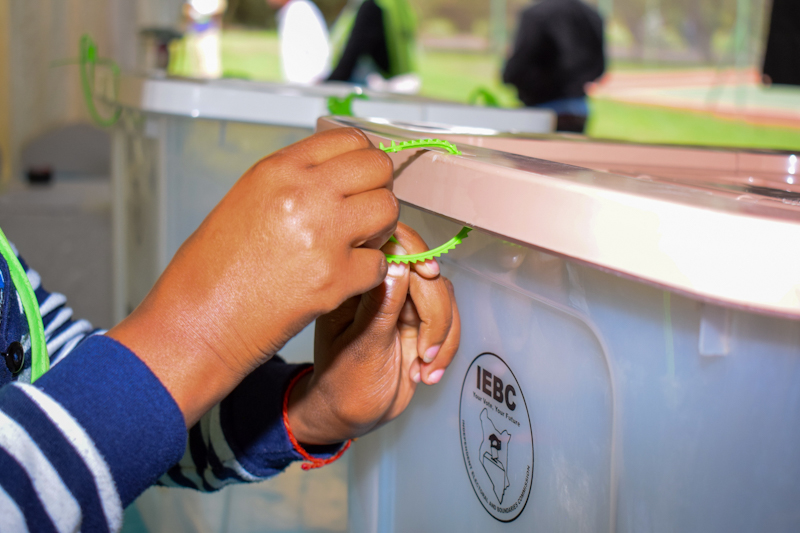
Kenya is paying a steep price to run elections, with the amount spent on each registered voter far exceeding the international norm as electoral authorities invest heavily in security, technology, logistics and measures intended to win the confidence of political players and voters.
A new report has put the spotlight on the rising financial burden of conducting elections, showing that Kenya’s spending per registered voter is almost three times the global average of about $5 (Sh645).
The Cost of Elections in Kenya 2026 report says the country spent Sh54 billion on the 2017 General Election and another Sh36 billion on the 2022 polls. While the overall bill fell in 2022, the expenditure per voter remained considerably higher than the international benchmark.
According to the study by the Netherlands Institute for Multiparty Democracy, the 2022 election translated to an expenditure of Sh1,649 for every registered voter. When calculated against the number of people who actually voted, the figure rose to Sh2,566 per ballot cast.
The 2017 election cost Sh2,124 for every registered voter.
The study was conducted under the Promoting Inclusive Electoral Reforms in Kenya programme and examines the factors behind the high cost of organising and managing elections in the country.
At the heart of the problem, it says, is the political environment surrounding elections, particularly the deep lack of confidence in institutions responsible for managing the process.
The concern has also reached Parliament, where Molo MP and Finance and Planning chairman Kuria Kimani has questioned whether the country is getting value for the money committed to elections.
Speaking on the floor of the House, Kimani said he had conducted a small analysis of election expenditure and established that the cost came to about Sh2,600 for each vote cast.
“How does that compare with the cost of casting a vote in other jurisdictions? For example, if we compare that with South Africa, it costs four times more in Kenya than it does in South Africa. This means that, at the same cost as one vote in Kenya, four votes could be cast in South Africa,” he said.
Kimani also raised questions about the amount spent on ballot papers, especially the cost attributed to their security features.
“Let us not lose track of the cost of printing a ballot paper in this country. I said it is the highest in the whole world. The chair of JLAC is talking about security features, but the cost of printing a banknote in Kenya is Sh6.84, with all the security features. There is no way you can tell us that, because ballot papers have security features, it costs us Sh2,600.”
The report identifies mistrust of electoral institutions and the election process as the biggest reason Kenya's elections require such high levels of spending.
“The most critical driver is mistrust in institutions and the electoral process itself,” the report says.
This lack of trust, it adds, has created pressure on the electoral agency to spend more on systems and safeguards that can persuade political actors and the public that elections are credible.
The report says the electoral agency is forced to “buy” credibility through technology, security features and legal safeguards.
Technology therefore becomes not only a tool for managing elections but also part of the effort to address doubts surrounding the process. Security measures and legal protections add to the bill as authorities seek to prevent disputes and reassure those taking part in elections.
The way elections are funded has also contributed to the problem, according to the study.
The report says Kenya largely treats election financing as a major expense that rises during polling years instead of maintaining it as part of a continuous five-year governance cycle.
Funding for the Independent Electoral and Boundaries Commission increases sharply when elections approach and then drops between election periods.
The study says this “stop-start” approach affects the ability of electoral institutions to maintain continuity and prepare properly between polls.
It can also result in tighter procurement schedules, more emergency spending and repeated purchases of electoral technology that could otherwise be maintained, upgraded and reused over a longer period.
Rather than concentrating large expenditures in the months leading up to elections, the report says investment could be spread across the five-year cycle.
Such an approach would allow existing systems and equipment to be maintained and improved between elections, reducing the need for repeated procurement and limiting pressure on the budget when a poll draws near.
Operations and logistics remain the biggest area of election expenditure.
The work covers more than 300,000 temporary election officials who are required to administer the polls across the country. It also includes moving and storing election materials before and after voting.
The scale of the operation is further illustrated by the more than 46,000 polling stations that have to be supplied and managed during elections.
With such a large network to coordinate, the report says logistics account for a major share of the election budget, adding to the costs already created by technology, security and efforts to address the trust deficit.
The findings place the cost of Kenya’s elections under renewed scrutiny as the country considers how to make future polls more affordable without weakening the safeguards and systems used to protect the credibility of the process.