
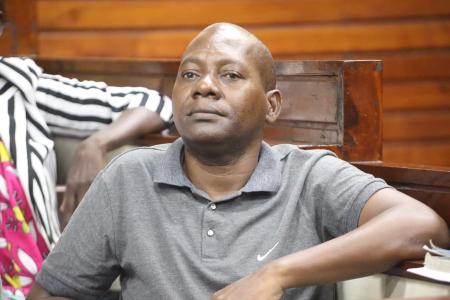
The fate of Paul Nthenge Mackenzie and 30 others accused of murder in the Shakahola deaths now rests with the High Court, after prosecutors urged the court to find them guilty over the deaths of 191 people, among them 190 children, while the defence insisted that the evidence falls short of the standard required for conviction.
In their final submissions ahead of Monday’s judgment, prosecutors argued that the deaths followed a religiously motivated fasting practice in which Mackenzie allegedly directed followers to starve themselves in anticipation of meeting Jesus Christ in heaven.
The state said Mackenzie, also known as Mtumishi, Nabii and Papaa, was linked to instructions that encouraged followers to continue fasting until death. It maintained that the accused had different roles in a coordinated practice that ultimately resulted in the loss of lives.
"Based on evidence, the victims likely died from starvation, accounting for 99 percent of cases. The other two were caused by direct human action, the Director of Public Prosecutions (DPP) said.
To support its case, the prosecution pointed to accounts involving parents of children who survived. It said the parents’ verbal instructions to enter maombi, or prayers, referred to fasting until death and, when assessed alongside other evidence, showed how the practice was promoted.
The state also referred to testimony concerning an alleged suicide pact, arguing that the evidence presented in court connected the recovered bodies to starvation. It said this link remained relevant even where investigators could not establish the identities of the deceased or determine their precise causes of death through medical examinations.
Prosecutors further told the court that some members of Good News International Ministries, the church associated with Mackenzie, could not account for how their children died. Others among the accused, the state said, acknowledged that their children had fasted to death.
The prosecution rejected the possibility that the deaths could be explained by natural causes. It also dismissed suggestions that medical conditions such as fatty liver, linked to prolonged alcohol abuse, could explain what happened to the victims.
The state asked the court to assess the evidence as a whole rather than rely only on individual medical findings. It argued that limitations in establishing the exact cause of death in some cases did not prevent the court from drawing reasonable conclusions from the wider circumstances.
The investigation involved several state agencies and led to the discovery or exhumation of more than 429 bodies. Investigators also carried out forensic examinations, reviewed crime-scene records and collected accounts from relatives of people suspected to have died in the incident.
According to the prosecution, approximately 400 statements were recorded, while 120 witnesses appeared in court to testify.
The wider investigations resulted in 95 people being charged with offences that included homicide, organised crime, radicalisation and crimes against children.
In urging the court to convict the accused, prosecutors argued that the state could not stand by while vulnerable people lost their lives under the circumstances described in the case.
"The state ... cannot remain passive while its most vulnerable citizens are slaughtered," the prosecution submitted.
Defence challenges prosecution evidence
The defence urged the court to acquit all 31 accused, arguing that the prosecution had not established their guilt beyond reasonable doubt.
Lawyers representing the accused said the court needed to examine whether the identities of the victims had been adequately established and whether the religious beliefs and practices presented by the prosecution could legally be linked to the deaths.
They challenged the strength of the evidence, citing what they described as "gaps, inconsistencies and reasonable alternative explanations" that, in their view, prevented the court from safely reaching a guilty verdict.
The defence acknowledged that the deaths of 190 children and one adult were not in dispute. However, it argued that the existence of the deaths alone did not establish that the accused had caused them or played a role in their occurrence.
"No one disputes the deaths of 190 children and one adult. The issue for determination is whether the accused persons can be said... to have had a hand in those deaths," the defence said.
The lawyers also questioned whether the prosecution had adequately established the causes of death, maintaining that criminal responsibility could not be based on assumptions or suspicion.
They argued that where the cause of death remained unknown, the prosecution had failed to prove an essential part of the murder charges.
Court faces key questions
At the centre of the case is whether the evidence presented by the prosecution sufficiently connects the accused to the deaths and establishes the elements required to prove murder.
The state has relied on witness testimony, forensic findings, statements from relatives and circumstantial evidence to support its argument that the deaths resulted from organised, religiously motivated fasting.
The defence, on the other hand, has challenged the reliability and completeness of that evidence, arguing that unanswered questions about the victims’ identities, their causes of death and the alleged involvement of the accused should lead to acquittals.
The High Court must weigh the competing arguments and determine whether the prosecution has met the required legal standard to secure convictions against Mackenzie and the 30 co-accused.