
The government has been ordered to explain how it plans to commit public resources to the proposed Sh2.2 trillion Dangote refinery in Lamu, after a High Court petition raised questions over funding, land, tax benefits, guarantees and the planned State stake in the project.
Justice David Mburu has given the government and other parties seven days to respond to the petition filed by Francis Onyango Awino, who is seeking access to documents supporting Kenya's proposed participation in the massive petroleum project.
The judge on Tuesday certified the case as urgent and directed that the petition and the accompanying application be served physically within two days.
The court will hear the matter on a priority basis, with a mention scheduled for November 12 to establish whether the parties have complied with the court's directions and to give further orders.
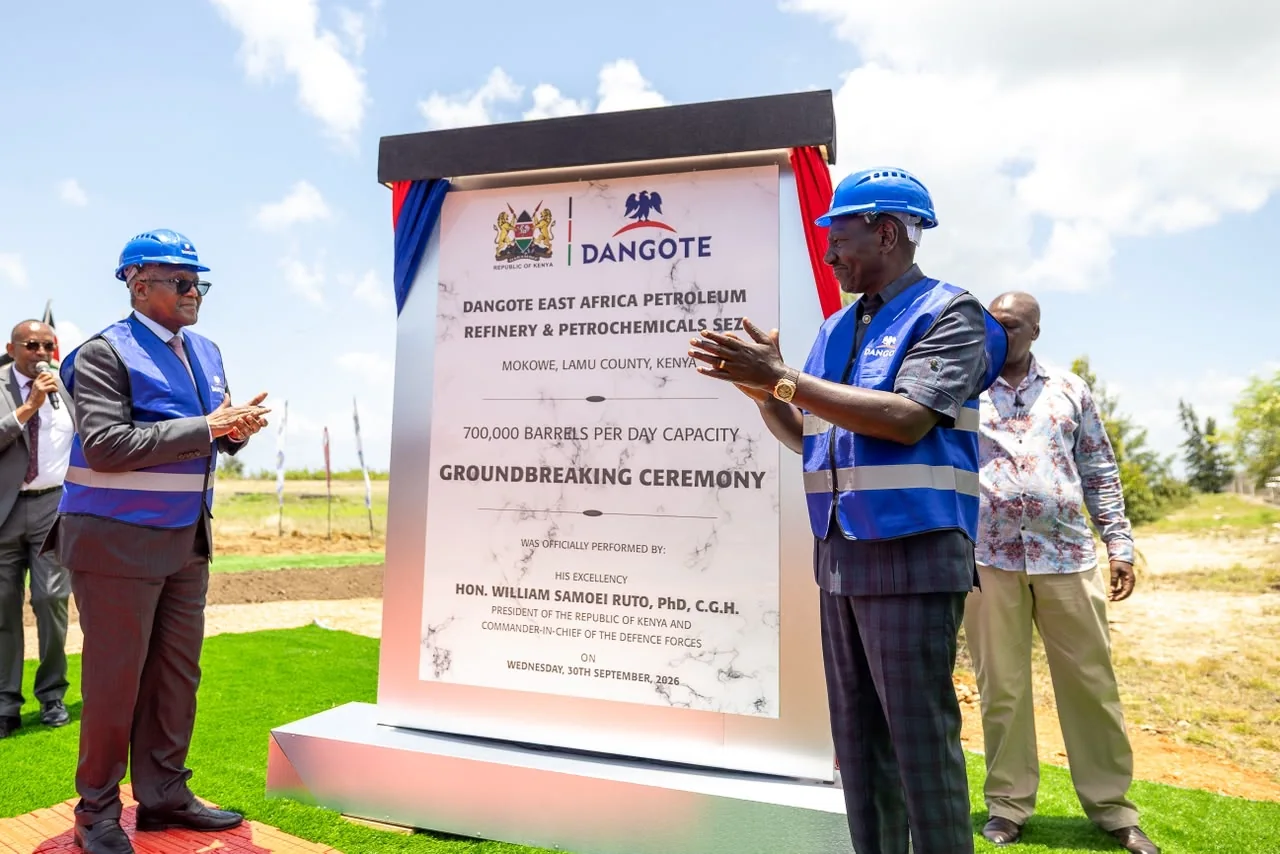
The legal challenge was filed shortly after President William Ruto and businessman Aliko Dangote broke ground for the refinery at Mokowe in Lamu County on September 30.
The facility, known as Dangote East Africa Petroleum Refinery and Petrochemicals SEZ, is planned to process 700,000 barrels of oil a day.
President Ruto has said Kenya intends to use the National Infrastructure Fund (NIF), together with public assets such as land, to acquire an interest in the project.
Awino, however, wants the government to disclose the agreements, approvals and other records that form the basis of the proposed investment.
He says he does not oppose industrialisation or legitimate foreign investment, but wants clarity on how public resources are being committed and whether the process has met constitutional requirements for openness and public participation.
"Article 201 of the Constitution requires openness, accountability and public participation in financial matters. This obligation is directly engaged where the State may deploy NIF funds, public assets, equity, land, tax incentives, exemptions, guarantees or other fiscal support," says the petitioner.
The petition names the Attorney-General, National Treasury officials, Energy and Petroleum officials, Lands officials, the National Environmental Management Authority, the National Land Commission, Lamu County Government, LAPSSET Corridor Development Authority, Kenya Ports Authority, Kenya Maritime Authority and the National Infrastructure Fund as respondents.
Dangote East Africa Petroleum Refinery and Petrochemicals SEZ and the Capital Markets Authority have been listed as interested parties.
Justice Mburu directed all respondents and interested parties to file their responses within seven days after receiving the court papers.
"The matter is certified urgent and Will therefore be heard on priority basis," the judge ordered.
Awino is seeking temporary orders to stop State agencies from entering into irreversible or non-routine commitments linked to the project before the court determines his petition.
The proposed restrictions cover NIF funds, public land, equity, guarantees, indemnities, tax concessions and other forms of government support.
According to his affidavit, the petitioner has not been given the legal instrument authorising NIF participation, details of the source and amount of funding or records showing the proposed level of government ownership.
He wants the State to provide documents on the valuation and proposed use of public land, as well as financial models, feasibility studies, due-diligence reports and records showing the approvals obtained for the project.
The requested information also covers proposed shareholder and governance structures, guarantees, indemnities and contingent liabilities that could arise from the government's involvement.
Awino is seeking details of tax concessions, exemptions and other incentives that may be granted to the project, together with environmental approvals and assessments.
He also wants access to project agreements and memoranda, procurement records and information held by the CMA relating to possible securities or share sale arrangements.
The petition further seeks environmental assessments, land records, procurement documents, tax incentives, licences and permits, as well as information identifying the directors and beneficial owners of the project company.
Awino says the documents are needed to determine "the legality, value, affordability, public benefit, fiscal sustainability, procurement, accountability safeguards and financial risk" of the planned government participation.
He argues that without the records, members of the public cannot properly assess the proposed investment or determine the possible financial risks and benefits to the country.
The refinery is expected to be completed in 2030 and is designed to help reduce East Africa's dependence on imported refined petroleum products.
President Ruto has previously said about 9,000 acres have been identified for the development, while another 3,000 acres are being sought to support an expanded project.
The President has also said the land earmarked for the development belongs to the government and that families occupying areas required for the project would be compensated.
The land question is already before the Environment and Land Court in Malindi, where 133 Lamu residents have challenged the proposed use of land registered as LR No. 13061 in Hindi/Manda Magogoni.
On September 25, Justice Jane Onyango ordered the parties to maintain the status quo on the disputed land until October 14.
The residents say their families have occupied and used parts of the property for generations. They are seeking recognition of their interests, compensation and protection of their homes and graves.
The Malindi proceedings did not prevent the September 30 groundbreaking ceremony. Instead, the court directed the parties to preserve the existing position while the residents' application is considered.
The Nairobi case is not seeking a ruling on ownership of the disputed land. Its focus is on the disclosure, legality and approval of the government's planned financial and related commitments to the refinery.
The $16 billion (Sh2.2 trillion) development is expected to include a 1,000-megawatt power plant alongside the refinery.