
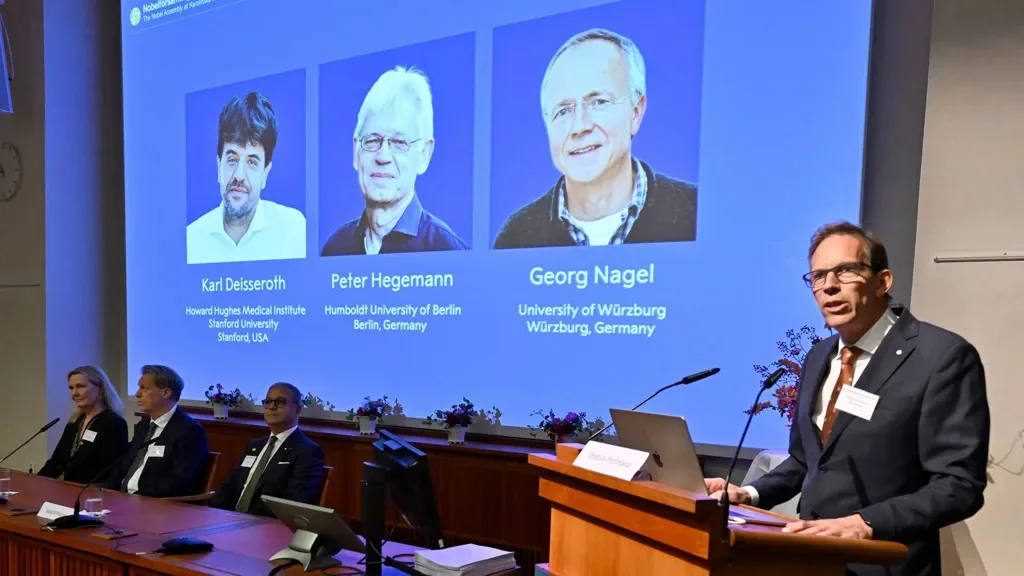
American psychiatrist and neurologist Karl Deisseroth, together with German scientists Peter Hegemann and Georg Nagel, have won the Nobel Prize in Physiology or Medicine for their work in optogenetics.
The Nobel Assembly says their research has transformed the study of the brain by allowing scientists to switch specific nerve cells on and off using light.
Optogenetics uses a light-sensitive protein originally discovered in algae to control the electrical activity of nerve cells.
Hegemann and Nagel helped identify the protein, while Deisseroth developed ways of using it to control neurons in the brains of animals.
The technique has enabled researchers to study brain circuits linked to memories, emotions and behaviour, providing new insights into neurological and psychiatric disorders.
The Nobel Committee says the method has also opened up potential medical applications. Researchers are testing optogenetics as a possible treatment for people with severe visual impairment, including those affected by retinitis pigmentosa.
In early clinical research, patients with damaged light-sensitive cells in the eye have regained limited vision using a combination of gene therapy and special glasses that deliver light to activate the therapeutic proteins.
The three laureates will share the Nobel Prize money, worth 12 million Swedish kronor.
The Nobel Assembly says their work has opened a new era in neuroscience and is helping scientists better understand one of the brain's biggest mysteries — how it produces thoughts, feelings and behaviour.