
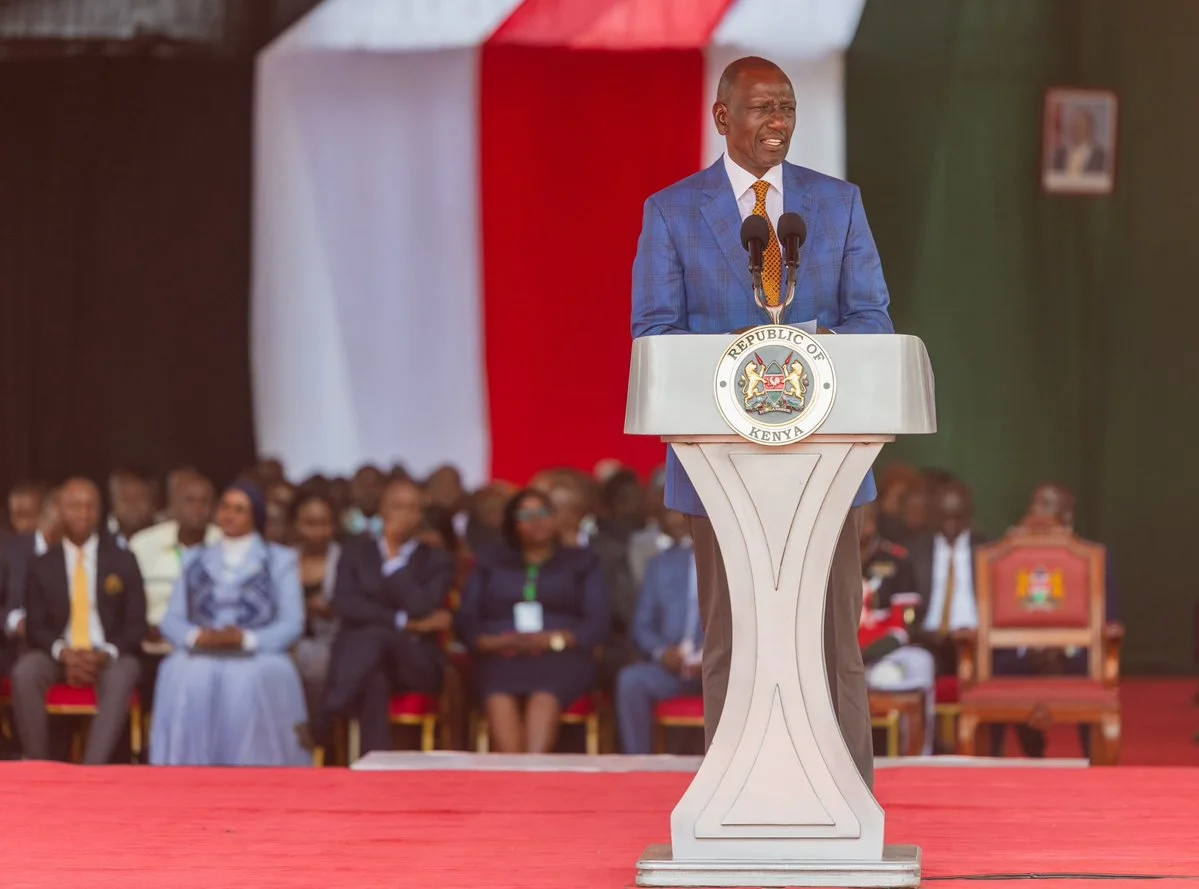
President William Ruto has called for Kenya to consider buffalo farming for milk production as the country battles dwindling dairy supplies, with prolonged drought and the rising cost of animal feed putting pressure on farmers and consumers.
Addressing the Agriculture and Food Transformation Summit at the ASK Showground in Nairobi, Ruto urged the livestock sector to look beyond conventional dairy farming and assess whether buffaloes could help increase milk production, pointing to countries such as India where the animals are widely kept for their milk.
The President said he had already asked the Principal Secretary for Livestock to explore bringing in improved camel and buffalo breeds, arguing that Kenya needed to expand its options for meeting demand.
“I had told the Livestock PS to bring in good breeds of camels and buffaloes. I hear buffaloes also produce a lot of milk. Tulikua tumesema tuanze na kidogo tuone hii buffalo, kama tunaweza kukamua. If others are milking them, why can’t we do the same? What is wrong with that? We need to diversify our sources of milk,” he said.
Ruto also drew attention to camel milk, describing it as a potentially profitable product for livestock farmers because of the higher prices it fetches in urban areas.
“In town, a litre of camel milk goes for Sh180, almost Sh200. It’s triple the cow’s milk, so it’s good for us to start to think; we’re currently facing a milk shortage because of drought,” he said.
His remarks come at a time when the dairy industry is experiencing reduced production as dry conditions affect grazing land and water supplies. Farmers have also been hit by higher feed costs, making it more expensive to maintain their animals and sustain milk output.
Buffalo milk could offer another option for expanding dairy production. The product is widely consumed in South Asia, where buffaloes play an important role in the dairy industry.
Compared with cow’s milk, buffalo milk generally has a higher fat content, with butterfat levels ranging from 7 to 8 per cent, against approximately 3 to 4 per cent in cow’s milk. This makes it useful for manufacturing dairy products such as butter, cheese, yoghurt and ghee.
It also contains higher levels of protein and calcium than cow’s milk. However, proper pasteurisation remains necessary to eliminate harmful bacteria and make the milk safe for consumption.
Kenya’s milk supply challenges have continued to raise concerns among consumers, retailers and processors, with the Kenya Dairy Board warning that shortages could last for at least another month.
Figures on formal milk deliveries to processors show a steady decline between June and August. Deliveries dropped from 84.4 million litres in June to 81.3 million litres in July, before falling to 75 million litres in August.
The decline has affected the availability of some milk brands on supermarket shelves, while prices of available products have risen by as much as 30 per cent.
Nairobi, Mombasa, Kisumu and Nakuru are among the urban centres facing supply pressure, as high daily consumption in these markets places further strain on the milk available for distribution.
Ruto’s proposal is part of a wider push to improve livestock breeds and expand agricultural production. By considering camels and buffaloes alongside conventional dairy cattle, the government hopes to identify additional ways of supporting milk production and strengthening the livestock sector.
However, bringing buffaloes into Kenya’s dairy industry would require assessments of the breeds suited to local conditions, their feeding and water needs, and the animal health measures necessary to support their production.
The country would also need to consider milk handling and processing requirements, as well as whether buffalo farming could operate profitably on a commercial scale.
These factors would be important in determining whether buffalo milk could become a practical addition to Kenya’s dairy industry as the government seeks ways to address supply shortages and give farmers more options for earning an income.