
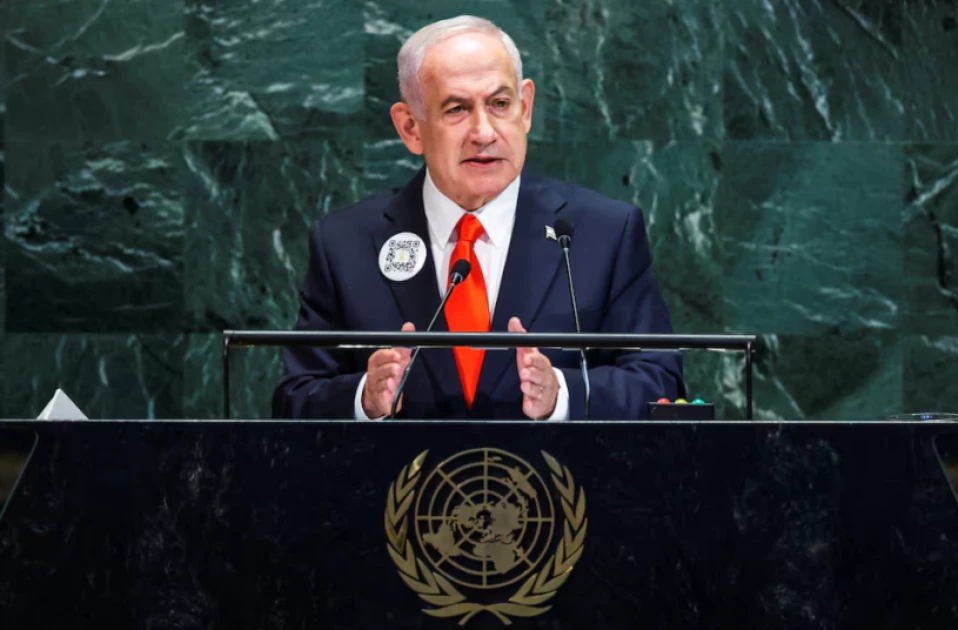
Dozens of delegates walked out of the United Nations General Assembly as Israeli Prime Minister Benjamin Netanyahu began his speech on Thursday, September 24, 2026, prompting him to launch a strong defence of Israel’s military actions in Gaza and against Iran.
With large parts of the chamber empty, Netanyahu used the address to respond to international criticism of Israel, defend its campaign against Hamas, explain the decision to strike Iran’s nuclear facilities and warn of what he described as continuing threats to Israel’s security.
He began by challenging those who had chosen to remain in the hall after the walkout.
“If there are any other moral cowards who haven’t yet left this hall—please do so now. Thank you very much,” he said.
Israel’s case against Iran
Netanyahu devoted part of his speech to Iran’s nuclear programme, returning to a warning he had made in 2012 about the possibility of Tehran acquiring nuclear weapons.
He said Israel’s decision to target Iran’s nuclear facilities had been difficult to carry out but necessary to prevent what he described as a deadly threat.
“Devastating Iran’s nuclear facilities was hard. It was very hard to do. But for me, it was one of the easiest decisions I’ve ever had to make as prime minister. Because if we hadn’t done it, we’d all be dead,” he said.
He further argued that Israel’s military campaign against Iran had implications beyond its own borders, saying other countries had also benefited from the action.
“In defending itself, Israel is also defending many of the countries whose delegates just left this hall!” Netanyahu said.
The Israeli prime minister also recalled his brother Yoni Netanyahu, who died during the 1976 Israeli operation to rescue hostages held at Entebbe Airport in Uganda.
He cited a conversation with Yoni before the 1967 Six-Day War, recalling his brother’s words:
“We’re going to win. We have no other choice.”
Netanyahu returned to the phrase several times during his speech as he explained his approach to the threats facing Israel.
Strong defence of Gaza campaign
The war in Gaza was another central part of Netanyahu’s address, with the Israeli leader describing the October 7, 2023, Hamas attack as the darkest day in Israel’s history.
He said 1,200 Israelis were killed during the attack and described the conflict that followed as a “seven-front war”.
According to Netanyahu, the fighting has involved Hamas, Hezbollah, the Houthis, Iran and allied militias.
He rejected accusations that Israel had committed genocide in Gaza, describing the claim as false while defending the steps taken by his government during the war.
“Accusing Israel of genocide is the greatest lie of the century,” Netanyahu said.
He also referred to US military expert Colonel John Spencer, using his assessment to support Israel’s position on civilian protection.
“Israel has done more to prevent civilian casualties in war than any other military in history.”
Netanyahu said Israel had taken several measures aimed at warning civilians and limiting harm during its military operations. These included issuing warnings, dropping leaflets and allowing food and medical assistance to enter Gaza.
Mamdani comes under attack
Netanyahu also singled out New York Mayor Zohran Mamdani during the address, accusing him of spreading claims against Israel and saying Jews in New York no longer felt safe.
The Israeli leader directly addressed Mamdani as he pushed back against criticism of Israel.
“You can’t silence me. You can’t silence the truth,” Netanyahu told Mamdani.
He then rejected the genocide allegations against Israel, saying:
“Israel didn’t commit genocide. Israel prevented genocide.”
Netanyahu also took aim at Western European governments over their response to Israel, arguing that some had opted for weakness and appeasement.
Message to Iran
As he turned back to Iran, Netanyahu addressed protesters in the country and expressed confidence that the current government would eventually lose power.
“One day, and it may not be far away, the Iranian people will be free,” he said.
The comments formed part of Netanyahu’s wider argument that Israel’s military actions were necessary to deal with threats from Iran and other groups.
He ended his speech by drawing on Jewish history, quoting Mark Twain and a biblical verse before returning to the message that had featured throughout his address.
“We have no other choice.”