
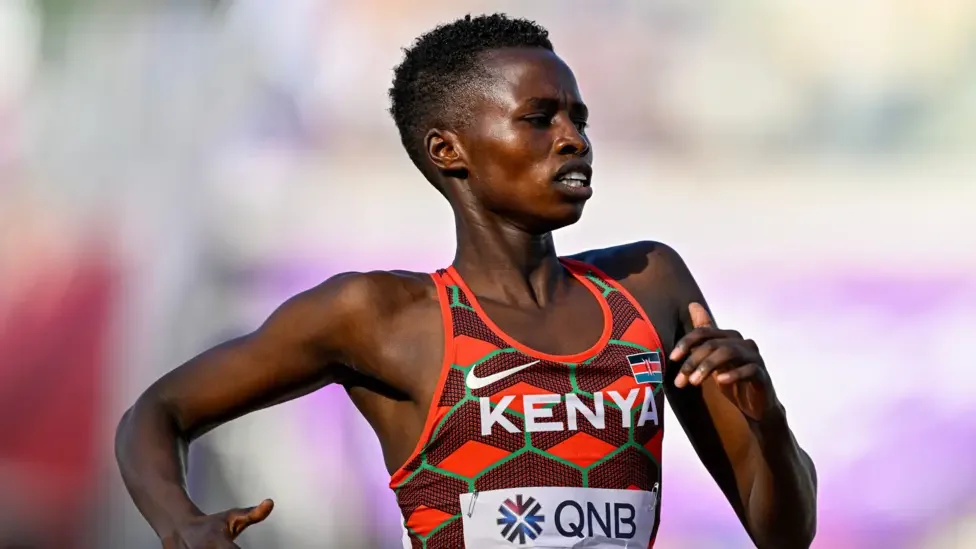
At a time when most young athletes were dreaming about how fast they could run, Naomi Korir was worried about something else — how far she could go without her body betraying her.
The Kenyan runner was born with a congenital fistula that caused urine to leak continuously, a problem that followed her through childhood and forced her to scale back her ambitions on the track. Thirteen years later, after three operations and years of living with the condition, Korir finally found relief and began rebuilding a life that has now taken her to the Commonwealth Games mile final.
The 28-year-old finished fifth in the mile final in Glasgow in August, marking the biggest moment yet in a career that began under circumstances that could easily have kept her away from athletics.
As a child, Korir took part in almost every sport she could find, including football, netball, athletics and rugby.
"I played most of the sports activities: football, netball, athletics, even rugby," she said as quoted by BBC.
But athletics presented a particular challenge because of the urine leakage caused by the fistula.
"But it was difficult because [of] the training, and the urine is flowing continuously. It's bad.
"I reduced my running to shorter distances to reduce the leaking.
"I began doing 100m hurdles."
Even with the difficulty, Korir continued taking part in sport. Athletics became more than just an activity for her; it gave her somewhere to belong at a time when she felt isolated from others.
"I could do it because I loved it," she explained.
"Because most of the people could avoid me, I did a lot of activities just to pass time and not to feel that I'm excluded."
Three operations before a new beginning
Korir was born with genitourinary tract fistula, an abnormal opening between the bladder and vagina that resulted in the constant loss of urine.
Unlike fistula cases linked to childbirth, hers was congenital. Doctors Without Borders estimates that about 500,000 women worldwide live with fistula.
The condition has become rare in some countries where women have access to good obstetric care and surgery, but it remains a problem in sub-Saharan Africa, where many women still struggle to access quality medical treatment.
For Korir, getting treatment was not straightforward.
Her first two surgeries failed to correct the problem. It was not until August 2013, when she was 13, that a third operation finally stopped the leakage.
The surgery was carried out in Eldoret, her home town, at Gynocare Hospital, which specialises in fistula, obstetrics and reproductive health.
For women living with fistula, the physical effects are often accompanied by social and emotional challenges.
Gynocare director Caroline Mabeya told BBC Sport Africa that many women are pushed away from their communities because of the condition.
"It's a difficult condition to live with every day," Mabeya said.
"They are ostracised in the society. That's the psychological torture that they face with the fistula."
Gynocare began operating in 2011 and has treated patients from across East Africa. Its work includes surgery as well as support intended to help women regain confidence and return to their communities.
"We offer free treatment for these women at Gynocare because most of them are very poor," Mabeya explained.
"When they come into the facility, they are crushed, they have low esteem. So, there's a huge amount of effort that is put in to make them at least be strong enough to be reintegrated and get back into the community."
Finding her way back to sport
The successful operation did more than end Korir's physical struggle. It opened the door to a new life, allowing her to pursue both education and athletics without the restrictions that had affected her as a child.
Through Gynocare's Young Fistula Programme, she continued her education after the operation and remained connected to the facility that had helped her overcome the condition.
"I have a family in GynoCare, a fistula home," she said.
"That is where I schooled after my surgery until I finished my secondary level."
Korir eventually returned to competitive athletics and began her professional career in 2019.
Her breakthrough on the international stage came two years later when she formed part of the Kenyan team that won silver in the 2x2x400m mixed relay at the World Relays in Poland, alongside Ferguson Rotich.
In 2022, she went a step further by helping Kenya win gold in the 4x400m relay at the African Championships in Mauritius.
Her progression reached another level this year when she lined up in the mile final at the Commonwealth Games in Glasgow.
It was her first appearance in a major global final, and she responded by finishing fifth.
For Korir, the achievement carries meaning beyond the result on the track. She wants young women who have lost hope to see in her story the possibility of rebuilding their lives.
"I'm giving hope to young women maybe who have lost hope," she said of her achievements.
"They need to come back again in living and enjoying life."
Mabeya has also watched Korir's journey from a young patient struggling with fistula to an athlete competing on the international stage.
"She makes them realise that you can actually pull yourself out of these struggles and still make it in life and succeed.
"Naomi actually is one of those patients that inspires us to continue working very hard, because we struggle with this condition and these women. The work is not easy."
Before athletics became her profession, Korir had imagined a different future. She sang in church and played the keyboard and believed music could become her career.
"But now I'm in different career and I'm so happy," she beamed.
With the World Championships in Beijing next year and the Los Angeles Olympics in 2028 on her mind, Korir is already looking ahead to bigger opportunities.
She has already conquered the condition that once dictated how she ran and shaped much of her childhood. Now she wants to prove herself at the highest level of athletics.
"I know I'm a champion in life, because conquering fistula alone is being a champion.
"Now I'm looking forward to be a champion in sport."