
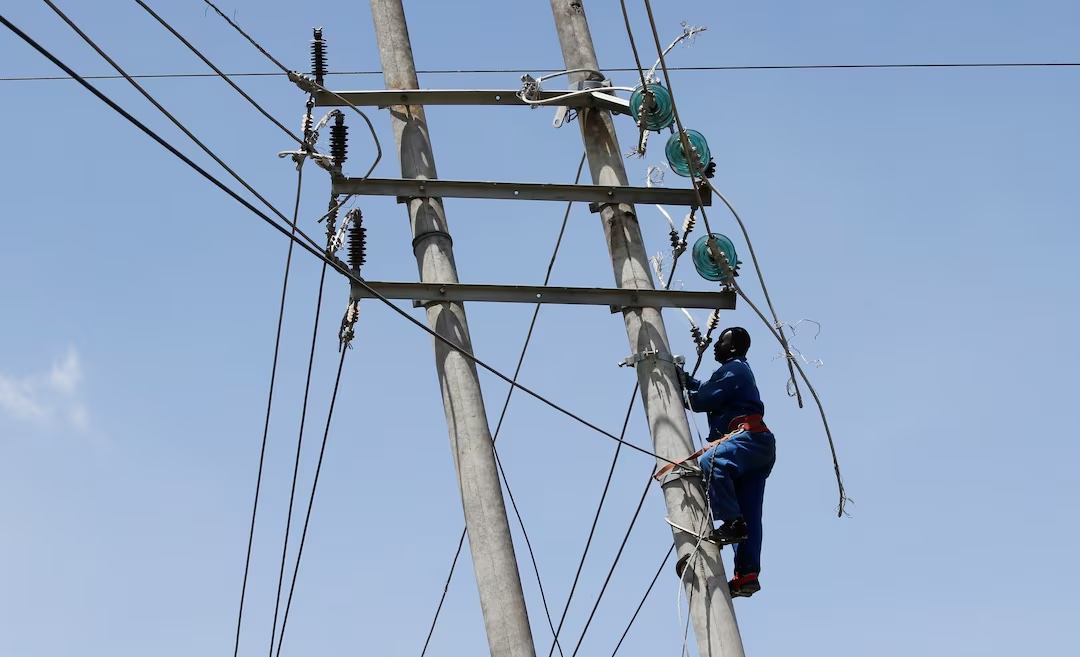
Lodwar town and surrounding areas in Turkana County are set to receive electricity from Kenya’s national grid for the first time since independence, in a development expected to transform power supply in the region.
In a statement on Monday, Kenya Power says it is nearing completion of two government-funded projects worth a combined Sh1.01 billion that will connect the town to the national grid.
The works comprise a 66/11kV Lodwar substation and a 90-kilometre 66kV power line between Lokichar and Lodwar.
Once completed, the connection is expected to provide stable electricity to more than 80,000 residents, powering homes, schools, health facilities and businesses while providing capacity for future demand.
The project comes against a backdrop of historically low electricity access in Turkana. County-level data from the 2019 Kenya County Fact Sheets showed that only 8.8 percent of households in Turkana had access to electricity, up from 2.4 percent in 2009. The county ranked 47th nationally on household electricity access.
Turkana County had a population of 926,976 in the 2019 census, including 140,791 people living in urban areas. Lodwar, the county headquarters, had 82,970 residents according to the same census.
Kenya Power Managing Director and Chief Executive Officer Dr Joseph Siror said the project would end Lodwar’s longstanding dependence on diesel-powered generation.
“This is one of those projects which we hold very dear to us. Since independence, the people of this area and this county have depended on generators, which are not very effective, especially in this area, where the temperatures are quite high and running the machines on a 24-hour non-stop basis leads to breakdowns. Connecting this town to the grid means that the residents here will enjoy stable and reliable electricity to power their livelihoods,” he said.
At present, Kenya Power operates diesel generators to supply electricity to Lodwar and surrounding areas at an estimated annual cost of about Sh900 million.
The company says the generators have struggled to meet growing demand, with Turkana’s high temperatures placing additional pressure on the machines and contributing to breakdowns and power rationing.
The financial implications are significant. Kenya Power estimates that the annual cost of diesel fuel for the isolated generation system is almost equivalent to the cost of extending the national grid to Lodwar.
“The cost of extending the power line from Lokichar to Lodwar, is almost the same as what we are currently using to fuel the generators in a year. Once these projects are complete, we are looking at a situation where what we are saving just in terms of diesel costs for a year is equivalent to the cost of building the line and the substation,” Siror said.
Kenya Power’s own investment documentation describes the Lodwar project as a 10MVA, 66/11kV substation with associated lines. A 2025 national energy planning document listed the project as comprising the substation and an 86-kilometre 66kV incoming line, while Kenya Power’s more recent project information puts the line length at about 90 kilometres.
The grid connection is expected to reduce the town’s dependence on fossil-fuel generation and eliminate emissions associated with running the diesel generators.
The impact is expected to extend beyond household electricity.
Kenya Power says reliable power could stimulate investment in livestock trade, tourism, agribusiness, mining and other industries in Turkana, while supporting small and medium-sized enterprises.
Schools are also expected to benefit from longer and more reliable study hours, while ICT hubs and digital businesses could operate with fewer interruptions.
Health facilities stand to gain from a more dependable electricity supply for essential services, including the storage of vaccines and other temperature-sensitive medical supplies.
The wider county still faces substantial energy challenges. Turkana’s county energy database reports that 64 percent of surveyed households never access electricity, while 28.9 percent report accessing it daily. The same database shows that 52.3 percent of households say they cannot afford electricity.
Turkana County has also acknowledged persistent gaps in affordable and reliable energy, with authorities prioritising grid and off-grid electrification alongside clean-energy solutions.
For Lodwar, the national grid connection represents a shift from an isolated diesel-based system to a more dependable electricity supply.
Kenya Power says the new infrastructure will not only meet current demand but also create room for future expansion as Lodwar grows as Turkana’s commercial and administrative centre.
The company has not specified the exact date when the connection will become operational, but says the two projects are nearing completion.