
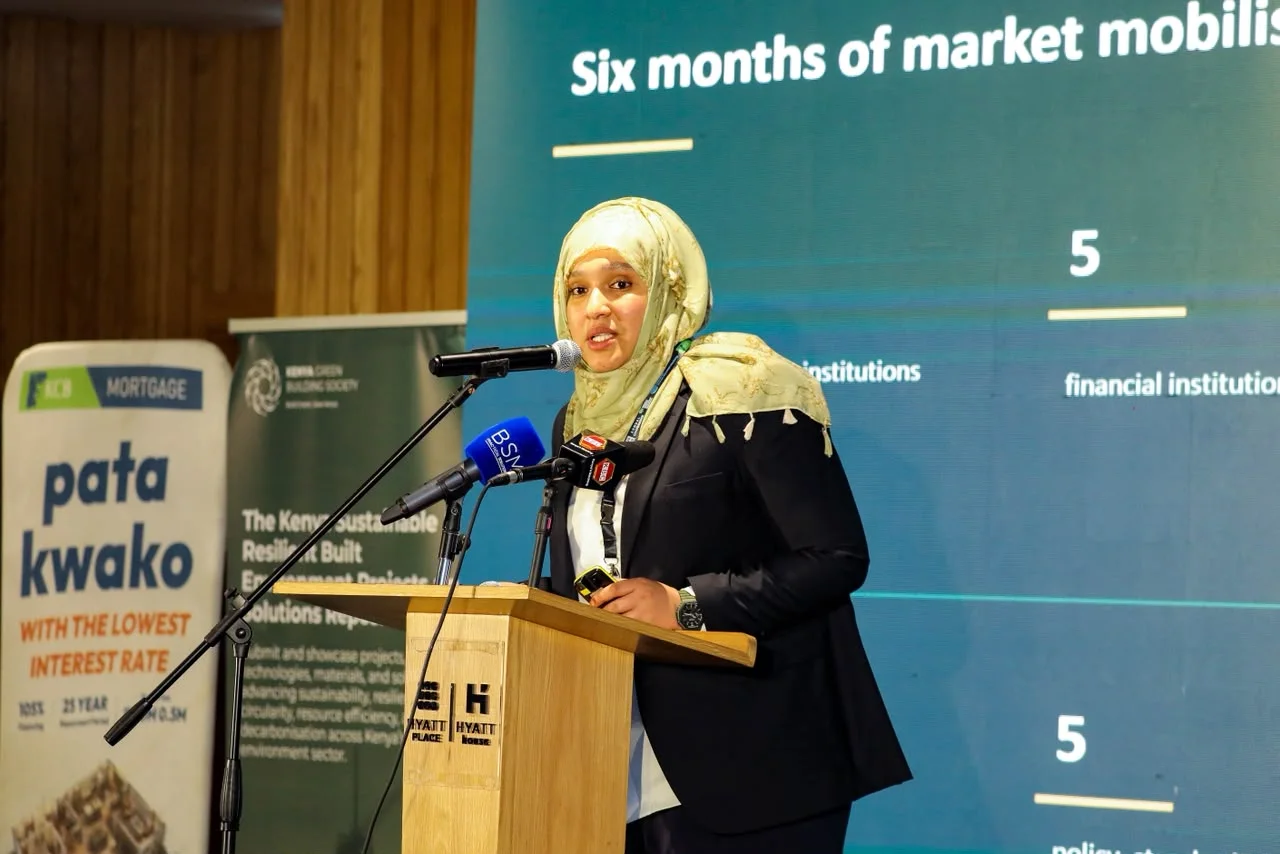
Kenya is stepping up efforts to transform its built environment into a low-carbon, climate-resilient and investment-ready sector, with the Kenya Green Building Society (KGBS) calling for greater collaboration between the government, financiers and industry players.
Speaking during the KGBS Annual Conference 2026 in Nairobi, KGBS Chief Executive Officer Nasra Nanda said sustainability must move beyond policy discussions and translate into actual projects supported by financing, risk management and investment.
She said KGBS has been partnering with financial institutions, including KCB Bank, Absa Bank and the Kenya Development Corporation, to ensure green building projects are not only environmentally sustainable but also bankable and capable of attracting investment.
KGBS is focused on four pillars: policy and standards; materials, industry and decarbonisation; finance, risk and investment; and development and implementation.
Kenya is seeking to expand its affordable housing programme while reducing emissions associated with construction, with decarbonisation efforts targeting the built environment and its supply chain.
KGBS is also focusing on climate resilience, particularly as Kenya prepares for the expected El Niño rains and the effects of extreme weather.
“Buildings and infrastructure must increasingly be viewed as investments in resilience rather than simply construction projects,” Nasra Nanda said.
On policy, KGBS has contributed to the draft Green Building and Sustainability Framework being developed by the State Department for Public Works.
The society has also worked with the State Department of Industry and the United Nations Industrial Development Organization on a Green Public Procurement Roadmap, with the cement and steel sectors taking the lead in the discussions.
The conference also marked the launch of the Kenya Sustainable Built Environment Repository, a national platform designed to consolidate fragmented information on sustainable and climate-resilient projects, products and technologies.
The repository's initial database contains 252 project records and 118 products and solutions.
According to KGBS, the documented projects and solutions represent an annual potential impact of 1.47 million tonnes of carbon dioxide equivalent reductions, 226.3 million kilowatt-hours in energy savings, 1,396 megawatts of renewable energy capacity and 28,767 cubic metres in annual water savings.
The database has also captured 2,325 jobs, more than 116,000 beneficiaries and 2.9 billion dollars in identified investments in green, resilient and renewable energy components.
Speaking at the conference, Special Envoy for Climate Change Ambassador Ali Mohamed said green buildings are not only an environmental issue, but also an economic, industrial, housing, jobs and energy agenda. He added that Kenya's climate transition must be implemented where people live and work.
Principal Secretary for Environment and Climate Change Dr Festus Ng’eno challenged stakeholders to identify policy barriers, establish the evidence needed to unlock investment, identify projects ready for scaling and define the specific contribution each institution can make.
The conference comes as Kenya seeks to ensure that future urban growth and infrastructure development strengthen, rather than deepen, the country's exposure to climate risks.