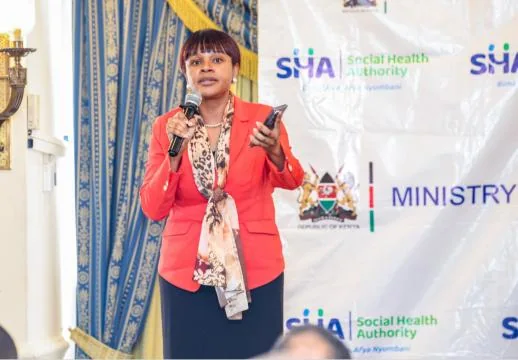
Healthcare providers have been put on notice that the grace period to join the new digital health system is running out, with the Social Health Authority (SHA) warning that facilities that fail to make the switch could lose their contracts.
SHA Chief Executive Officer Mercy Mwangangi said the authority would eventually have to decontract facilities that do not comply with the transition from the SHA provider portal to the Health Management Information System (HMIS).
She said the process was not being introduced suddenly, arguing that healthcare providers had been engaged and prepared for the change for the past six months.
"No Kenyan will lack care because of a system. We have engaged all providers in the last six months, and walked them through the journey on what it means to transition," says Dr Mercy Mwangangi, SHA Chief Executive Officer as quoted by the Daily Nation.
"No provider has been ambushed. This process started six months ago, a time will come when SHA will have to decontract some facilities" she adds.
The lengthy preparation period has also helped the government identify the need for more training among healthcare workers who operate the systems. The Digital Health Agency (DHA) is responsible for training providers as the country moves towards full adoption of the HMIS.
So far, about 6,427 public Level 2 to 4 facilities have completed the transition. Some Level 5 and 6 hospitals are yet to finish the process.
The programme also covers 523 faith-based organisations that provide services under SHA. Their migration will be supported through the Government-to-Government arrangement between Kenya and the United States.
Mwangangi said the goal was to have every healthcare provider connected, whether or not the facility has a contract with SHA.
"It is crucial that we have everyone migrate. In Kenya, our system is mixed, meaning service provision in the country is nearly 50- 50 between the public sector and private sector. If we want visibility of data that can help in policy decisions then everyone must be included" she explains.
The push for universal connection is linked to the government's plans to build a broad electronic record of healthcare services and patient information.
"We are building a robust Electronic Medical Records System that now has patient disaggregated data. Each patient interacting with a hospital will be visible to the authority and to the ministry," she says.
"This goes beyond SHA. We have been talking about malaria cases, or cancer cases ano wondering whether we have enough nets or radiology units. Now, the Ministry of Health as a policy decision making organ, will have patient disaggregated data with this information" she adds.
Mwangangi said the information could eventually provide the government with enough data to reduce reliance on some separate health surveys used to measure health indicators.
"My team will now be able to undertake quality surveillance activation," she says.
The information collected will also give SHA a clearer picture when checking claims submitted by healthcare facilities. Officials will be able to establish when a patient arrived, the healthcare worker who attended to them, the medicines they were given and when they left the facility.
The system is also designed to detect cases where patients receive services that may not have been necessary. Dr Mwangangi described this as "over production of medicine", giving the example of patients being admitted despite having conditions that could have been treated on an outpatient basis.
All information gathered from facilities will be held in a sovereign cloud that is owned and managed by Kenya.
Mwangangi said strict controls would be placed around access to patient information, including encryption, defined user roles and checks on why the information was accessed.
"Accessing that data will be rolebased access since it has heavy encryption, and it is managed by the digital health agency with strict guidelines on who can access it, how it can be accessed, and even audits of why it was accessed" explains Dr Mwangangi.
A transition committee has been formed to deal with concerns from healthcare providers, particularly private facilities that asked for additional time to prepare.
Among the issues raised is the number of HMIS systems available in the market and whether they have met the required standards.
"Some of the issues raised relate to the number of certified systems in the market. If you go to the DHA site as a vendor, you will be able to see the certification process until SHA can validate it, giving it a green light for use," she says.
DHA Chief Executive Officer Anthony Lenaiyara said facilities would have the freedom to select the HMIS provider they want, provided the system passes the agency's certification requirements.
He said the requirement for systems to work together is already provided for under the Digital Health Act of 2023, which requires them to be integrated and interoperable.
"There is no change in how we finance insurance. We are trying to make systems in hospitals seamless. To improve patient care, we need to collect enough information, reduce duplication and administrative work we just want to talk to your systems directly," he says.
Lenaiyara said the government was also making arrangements to help lower-level facilities that may not have the resources needed to complete the transition.
Under the Government-to-Government arrangement, DHA will provide such facilities with a basic HMIS without charging them. The facilities will only need to undergo training to use the system.
"We only need to train them. It is a decision they have to make. Apart from insurance, HMIS manages the processes and operations of the hospitals. We will give them the basic system to help them transition," he explains.
He said the government had faced a similar challenge when SHA replaced the former NHIF, when many public facilities were still operating largely through paper records.
"Previously, they would process a lot papers and books and take them to county offices and then to NHIF offices. As of today, 6427 public facilities are fully digitised and we have provided them with where to store data," he says.
Private hospitals, however, are in a different position because many already operate their own HMIS platforms. Lenaiyara said they do not have to replace those systems, but must have them certified by DHA.
"That certification is cardinal, so that the two systems are on the same level. If they are not on the same level, you will struggle to ensure that the two systems communicate with one another," he says.
The agency has developed a certification framework that sets out the documents facilities must submit and the changes they may need to make to their systems before they can be approved.
"We don't expect our private facilities to incur additional costs by buying new systems," he says.
However, certification will come at a cost, with the amount varying according to the level of each facility.
The new HMIS will also introduce a common International Classification of Diseases coding system, meaning doctors across the country will use standard codes when recording diseases and conditions.
The platform will further help patients identify the healthcare workers responsible for their treatment. Only doctors with valid licences will be allowed to treat patients and enter their details into the system.
As the final preparations continue, Lenaiyara said DHA was still listening to concerns raised by private providers but maintained that the transition period could not continue indefinitely.
"We are engaging with the private sector to understand their challenges and we are ready to walk with them. Time is up now for the transition," he says.