
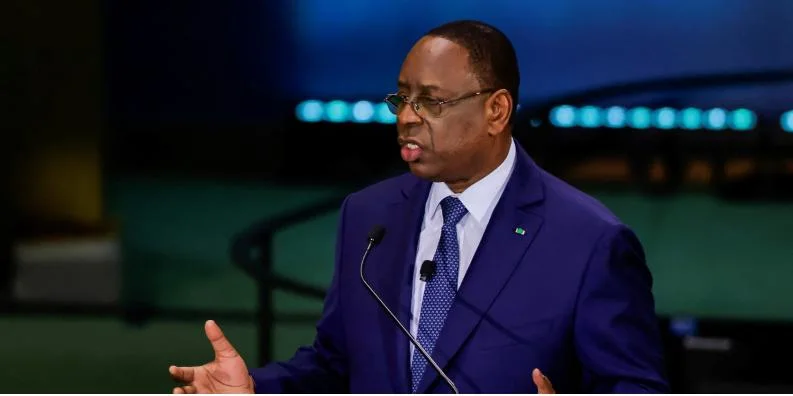
Former Senegalese President Macky Sall has pulled out of the race to lead the United Nations after failing to secure enough support in the latest Security Council assessment, dealing a fresh blow to his bid to succeed António Guterres.
Sall announced his withdrawal on Saturday, October 17, 2026, a day after the council's sixth informal poll showed that 10 of its 15 members opposed his candidacy, while only five backed him.
His decision followed consultations with Burundi's President Évariste Ndayishimiye and Senegalese President Bassirou Diomaye Faye, who had both supported his campaign to become the next UN Secretary-General.
“I have decided to withdraw my candidacy for that post,” Sall said in his statement.
The former head of state thanked Security Council members who had supported his bid, alongside his campaign team and the people of Senegal. He also expressed appreciation to the political leaders, civil society representatives, religious figures and traditional leaders who had stood behind his candidature.
Although he will no longer seek the position, Sall said he remained committed to the issues that formed the foundation of his campaign, including peace, security, economic and social development, international cooperation and dialogue between nations.
He also renewed his call for Africa to secure a stronger position in global decision-making, arguing that the continent's contribution to addressing international challenges should be matched by greater representation in global governance.
“Africa, which is at the heart of the challenges of peace, security, and development, must also continue to make its voice heard and pursue its efforts to occupy its rightful place in global governance,” he said.
Sall's exit followed a series of informal votes organised by the Security Council to assess the strength of the candidates before the formal selection process begins. During Friday's exercise, council members were asked to indicate whether they encouraged, discouraged or had no opinion on each contender.
The results placed Sall behind several rivals, further weakening his chances of securing the council's recommendation. In the first straw poll held in July, he received six votes in favour, seven against and two abstentions.
Costa Rica's Rebeca Grynspan recorded the strongest performance in the latest round, receiving nine votes of encouragement. Guyana's Carolyn Rodrigues-Birkett and Argentina's Rafael Grossi followed with eight supportive votes each.
The other candidates in the contest were Uganda's Olara Otunnu, Ecuador's María Fernanda Espinosa and Ecuador's Ivonne A-Baki.
However, the latest results revealed a major obstacle confronting all the candidates: opposition from the Security Council's five permanent members, China, France, Russia, the United Kingdom and the United States. Every contender received at least two discouragement votes from these powers, which can block a candidate through their veto authority.
Under the selection rules, a prospective Secretary-General must receive at least nine affirmative votes from the council's 15 members. The recommendation can still fail if any of the five permanent members exercises its veto, making their support a crucial factor in the race.
The informal polls are intended to help council members assess the candidates' prospects before deciding whom to recommend for the position. Their results are not binding, meaning candidates are not automatically eliminated after a poor showing, and additional rounds are expected before the final decision.
Sall's campaign had also experienced a shift in political backing within Senegal. The country initially declined to endorse his candidacy, prompting Burundi to nominate him for the position.
That position changed in July when Faye announced his support for Sall following a meeting between the two leaders. Faye, who chairs the Economic Community of West African States (ECOWAS), joined Ndayishimiye, the chairperson of the African Union, in backing the former Senegalese president.
With Sall out of the contest, Otunnu remains the only African candidate among the seven contenders. His continued presence keeps Africa represented in the race, although the wider competition is shaped by expectations that the next UN chief could come from Latin America.
The position has traditionally rotated among different regions, and Latin America is expected to have a strong claim in the current selection cycle. Most of the candidates seeking to replace Guterres come from that region.
Guterres' term ends on December 31, 2026. His successor must first be recommended by the Security Council before the UN General Assembly appoints the next Secretary-General.
Sall's withdrawal leaves the remaining contenders competing for support as the council works towards a decision on who will take over leadership of the global organisation.