
Nearly two decades after Kenya’s 2007–2008 post-election violence, survivors of sexual and gender-based violence are still seeking justice through the courts.
The survivors have returned to the Supreme Court in a case challenging what they describe as years of exclusion from compensation, recognition and other forms of support given to victims of political violence.
The case, brought by eight individual survivors alongside the Coalition on Violence Against Women (COVAW), the Independent Medico-Legal Unit (IMLU), the Kenyan Section of the International Commission of Jurists (ICJ Kenya), Physicians for Human Rights (PHR) and other interested partners, including Utu Wetu Trust and the Kenya Human Rights Commission (KHRC), challenges the alleged state's failure to prevent, protect against, investigate, prosecute, and provide effective remedies for widespread sexual violence committed during the 2007–2008 post-election violence.
“...this appeal asks the Supreme Court to determine whether survivors of conflict-related sexual and gender-based violence are entitled to the same constitutional protection, recognition, and reparations already extended to other victims of political violence,” read a statement seen by Radio Generation on July 29, 2026.
The case began in 2013 when survivors filed a constitutional petition at the High Court, accusing the state of failing to protect them from widespread sexual violence during the post-election crisis and failing to investigate and prosecute those responsible.
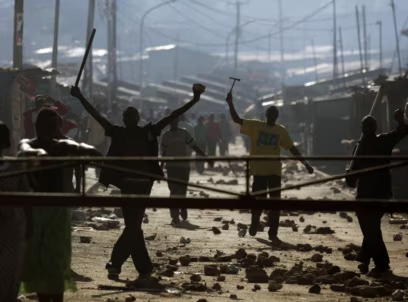
The violence erupted after the disputed 2007 presidential election, leading to widespread unrest, ethnic clashes and attacks across several parts of the country. Hundreds of thousands of people were displaced, and human rights groups documented cases of sexual and gender-based violence against women and girls.
The survivors argue that although the government has compensated some victims of political violence through various reparations programmes, survivors of sexual violence have largely been left out.
In earlier proceedings, the Court of Appeal found the state responsible in some cases and upheld compensation for survivors who suffered abuse by state security officers or had reported their cases. However, the court denied compensation to other survivors whose attackers were civilian groups or who had not reported the abuse to police.
The survivors have challenged that decision at the Supreme Court, arguing that it creates a “hierarchy of victims” and unfairly punishes people who could not report crimes during a period of fear, insecurity and trauma.
They argue that the state had information about the risk of violence and had a duty to protect citizens, investigate violations and provide remedies.
The appeal also raises questions over the role of the Independent Policing Oversight Authority (IPOA), with the survivors arguing that historical cases of police misconduct linked to the 2007–2008 violence should still be investigated.
Their lawyer, Willis Otieno, said survivors have waited too long for accountability.
“The lack of effective remedies still continues to date. No investigations have ever commenced 13 years later. Constitutional accountability cannot be conditional on expecting traumatized survivors to perform impossible tasks while state security organs stood by,” Willis said.
The survivors are asking the Supreme Court to order compensation, rehabilitation, public acknowledgment, an apology from the state, and reforms to prevent similar violations in the future.
The case comes as Kenya considers a national framework for managing claims and compensation for victims of political violence, with survivors calling for those affected by sexual and gender-based violence to be included.
“I have carried this pain for many years. I pray that this case will finally bring justice, not only for me, but for all survivors who have been waiting to be seen and heard,” said one survivor.