
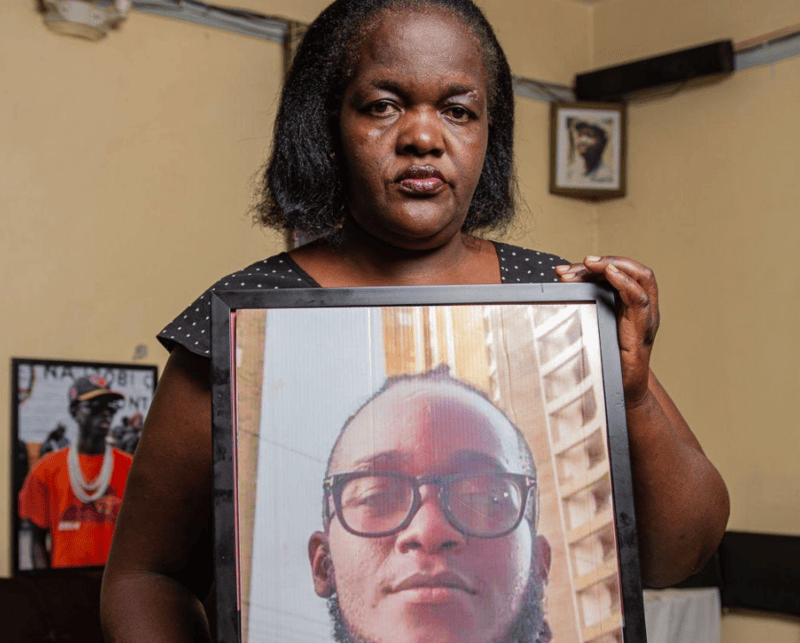
The Directorate of Public Prosecutions (DPP) has closed its case in the inquest into the death of 29-year-old Gen-Z protester Rex Masai, who was shot during the Anti-Finance Bill demonstrations in Nairobi on June 20, 2024.
Appearing before Milimani Principal Magistrate Geoffrey Onsarigo on Monday, Deputy Director of Public Prosecutions Jalson Makori told the court that the prosecution had called 30 witnesses and presented 48 exhibits.
The parties will now proceed to written submissions before the court makes its determination.
The prosecution’s decision to close the inquest followed the recall of IPOA forensic expert Joshua Mutua, who was asked to confirm the findings of video footage presented as evidence.
Mutua told the court that the one-minute-and-15-second footage was recorded on June 20, 2024, beginning at 7:18 pm.
He said the footage was internally consistent in its temporal sequence and visual continuity and had not been modified or altered during handling.
“Your Honour, I further found that no technical or intentional alteration, insertion, deletion, duplication, splicing, or rearrangement of video content was identified during the examination,” Mutua told the court.
He added that he signed the reviewed footage certificate on July 31, 2026.
Law Society of Kenya lawyer David Mwangi, who represents Masai’s family and the National Police Service, did not object to the closure of the inquest.
During the proceedings, a protected photojournalist identified as GG told the court that she had noticed similarities between photographs she took during the June 2024 protests and the appearance of a civilian police officer believed to be a key suspect in Masai’s killing.
IPOA had presented photographs taken on June 18 and June 20, 2024, showing an officer whose facial features and clothing it said were similar to those of the key suspect, Isaiah Murangiri Ndumba.
Murangiri was recalled to court to compare his appearance with the images and face cross-examination. He strongly denied that he was the officer captured in the photographs.
One of the images showed a man standing among uniformed officers wearing a black cap, dark grey short-sleeved shirt, blue jeans, black mask and white sports shoes, while holding a walkie-talkie and a button.
The witness also pointed out two wristbands she said the officer was wearing. One bore the Kenyan flag design, while the other had the initials “Izoo”.
“Please take me back to the June 20, 2024, photos where you will see the man in his left hand had a wristband with the initials of Izoo, while the right hand had the Kenyan flag art,” GG told the court.
She said her experience as a journalist made it easier for her to identify police officers operating in civilian clothing, citing footage of plain-clothes officers arresting protesters that she had submitted to IPOA and which was played in court.
During an earlier hearing on July 16, 2025, Murangiri had also denied being the man pictured in a blue shirt, black cap, blue trousers and black shoes while carrying a police walkie-talkie.
Mwangi further drew the court’s attention to what he said was a black birthmark beneath Murangiri’s left ear that appeared in the photographs. Murangiri denied having such a mark or being the person in the images.
“Please face the court beneath your left ear. Do you know of any spotting on your face? Please touch the bottom of it,” Mwangi asked.
The lawyer then asked the court assistant to zoom in on the photographs displayed on the projector for comparison. Murangiri maintained that he was not the person shown and said he was unaware of any birthmark on his face.
In his closing remarks, Mwangi urged Murangiri to check the alleged mark when he got home using a mirror.
The matter will be mentioned virtually on September 24, 2026, at 11:30 am for further directions.