
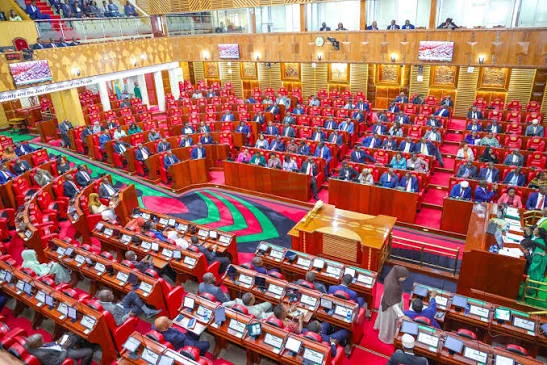
Kenya could use special seats to increase the number of women in Parliament for the next two decades under a proposed constitutional change aimed at finally resolving the gender imbalance in the National Assembly and Senate.
The Constitution of Kenya (Amendment) Bill No. 29 of 2025 proposes that additional seats be allocated after each General Election depending on the number of men and women who win elected positions.
The arrangement would be designed to ensure that neither gender accounts for more than two-thirds of the membership of either House.
The Bill, which is before the National Assembly, is sponsored by Deputy Speaker Gladys Boss Shollei, Dagoretti North MP Beatrice Elachi and Laikipia Woman Representative Jane Kagiri.
It proposes amendments to Articles 97 and 98 of the Constitution, which set out the membership of the National Assembly and Senate.
Under the proposed model, special seats would be determined after each election and used to correct any gender imbalance arising from the directly elected positions.
This means that where elections produce a Parliament dominated by men, additional women would be nominated until the two-thirds requirement is met.
The same formula would be applied in the Senate, where the 47 elected seats would be assessed and additional women nominated where necessary.
The proposal would mark a shift from the current system of fixed nominated positions. At present, the National Assembly has 12 nominated members, while the Senate has 16 nominated women senators, in addition to representatives of youth and persons with disabilities.
The proposed arrangement would have a 20-year lifespan.
Extension possible
The Bill contains a sunset clause under which the special-seat arrangement would come to an end 20 years after the first General Election held following the law's commencement.
There would, however, be room for the programme to continue for another 10 years.
Such an extension would require approval by at least two-thirds of National Assembly members and two-thirds of county delegations in the Senate.
The proposed changes come as women continue to hold a much smaller share of directly elected parliamentary seats.
In the 2022 General Election, 29 women won National Assembly constituency seats. The figure later dropped to 28 after Kandara MP Alice Wahome left Parliament to join the Cabinet.
The Senate has an even wider gap, with only three women among the 47 elected senators.
The special-seat proposal seeks to address the disparity by linking the number of nominations to the outcome of each election instead of maintaining a fixed number of positions.
A similar proposal is being pursued in the Senate by Majority Leader Aaron Cheruiyot through the Constitution of Kenya (Amendment) Bill No. 16 of 2025.
Cheruiyot's Bill also seeks to introduce gender top-up seats but differs from the National Assembly proposal in several areas.
His proposal sets aside five per cent of the special seats for persons with disabilities. It also limits people elected through the special-seat system to two terms.
Unlike Bill No. 29 of 2025, Cheruiyot's proposal does not provide for a sunset clause.
The push to settle the gender question comes 16 years after the adoption of the 2010 Constitution, which introduced the two-thirds gender principle.
Finding a way to resolve the continued failure to meet the requirement was also listed among the key issues addressed by the National Dialogue Committee (Nadco) report.